

When a patient is deciding who will perform surgery on their body, credentials are not a formality. They are the single most important trust signal a practice can communicate, and most plastic surgery practices bury them. Making surgeon credentials prominent in digital marketing is one of the highest-leverage changes a practice can make to its online presence, and the impact is evident in consultation requests and booking rates.
The Trust Gap in Elective Surgery Marketing
Patients Are Evaluating Risk, Not Just Results
Elective cosmetic procedures carry real surgical risk. Patients know this, even when they do not say it out loud. When they research a surgeon online, they are running a subconscious risk assessment: Is this person qualified? Are they board-certified? Where did they train? How long have they been doing this? A digital presence that leads with before-and-after photos but buries credentials sends the wrong signal. It suggests the practice knows its results look good, but is less confident about its qualifications.
Practices that lead with credentials, board certification, fellowship training, medical school, years of experience, and professional memberships tell patients immediately that there is nothing to hide. That transparency reduces perceived risk and moves the patient closer to booking.
The Internet Has Made Credential Verification Easy
Patients no longer have to take a practice’s word for its qualifications. Board certification status is searchable on the American Board of Plastic Surgery website. Medical licenses are verifiable through state licensing boards. Malpractice history is increasingly accessible. A patient who cannot find your surgeon’s credentials prominently displayed on your website will look elsewhere or find a competitor’s credentials instead.
Website design for plastic surgery practices should treat surgeon credentials as a primary content element rather than a footnote on the bio page. Every channel where patients encounter your practice, your website, your Google Business Profile, your social media, and your paid ads should communicate qualifications clearly.
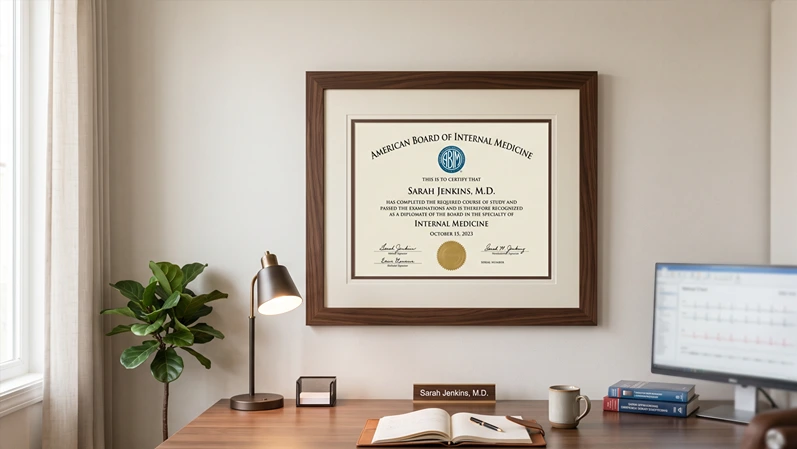
Where Surgeon Credentials Belong in Digital Marketing
On the Website: Above the Fold and Throughout
The surgeon bio page is the obvious home for credentials, but it should not be the only one. The homepage should reference board certification and years of experience in the hero section or immediately below it. Procedure pages should include a credential callout near the call to action. The about section should lead with qualifications before moving into personal story or philosophy.
Patients navigating a plastic surgery website rarely read linearly. They jump between pages based on what they are looking for. Credentials need to appear wherever a patient might be in that journey, not only on the page they may never reach.
In Google Business Profile and Local Listings
Your Google Business Profile is often the first place a patient encounters your practice. The business description is limited in length, but it should include board certification and specialty at a minimum. Local SEO for plastic surgery practices means optimizing every element of the GBP, including the services listed, the photos uploaded, and the description copy, to communicate both trustworthiness and specialty.
Patients who find your GBP in the local map pack and see a professional photo, a credential reference in the description, and a strong review profile are far more likely to click through than patients who find a GBP with minimal information and no credential signals.
In Paid Advertising Copy
Most plastic surgery paid ads lead with procedures or offers: “Book a Free Consultation,” “See Our Before and After Results,” “Limited Availability.” These are fine, but they miss an opportunity. Ads that reference board certification, years of experience, or fellowship training in the headline or description stand out in a competitive ad landscape because most competitors don’t.
Paid search ads for plastic surgery are expensive. Getting the click-through rate right by leading with trust signals rather than just procedure names improves return on ad spend and prequalifies patients before they even reach the landing page.
In Social Media Content
Surgeon credentials do not need to be posted as dry text. Social content that tells the story of a surgeon’s training, walks through what board certification means and why it matters, or explains the difference between a board-certified plastic surgeon and a cosmetic surgeon (a distinction many patients are unaware of) builds authority while educating the audience.
Social media management for plastic surgery practices should include a recurring credential content format, whether that is a monthly “Meet the Surgeon” post, a carousel explaining the training pathway, or a short video from the surgeon explaining their specialty and why it matters to patient safety.
IMAGE SUGGESTION: A plastic surgeon in professional attire speaking directly to the camera in a clean, modern clinic setting — no text overlay
How Credential Prominence Affects Conversion
It Reduces the Friction of the Unknown
The biggest barrier between a curious patient and a booked consultation is not price, not availability, and not procedure complexity. There is uncertainty about whether this is the right surgeon. Prominent credentials answer that uncertainty before the patient has to ask. Every moment a patient spends searching for credential information is a moment of doubt. Removing that search by putting credentials front and center removes a friction point that costs practices real bookings.
It Attracts the Right Patients
Patients who prioritize surgeon qualifications over price tend to be better candidates for consultation. They have done their research, they understand the value of experience and training, and they are less likely to shop purely on cost. Prominent surgeon credentials in digital marketing self-select for this patient profile, thereby improving not just consultation volume but also consultation quality.
It Differentiates Your Practice in a Crowded Market
In most markets, plastic surgery is a competitive category. Multiple board-certified surgeons are competing for the same patients. The practice that makes credentials easiest to find and understand wins the trust comparison. Branding built around a surgeon’s specific training, specialty, and philosophy creates a differentiated identity that generic “results-first” marketing cannot match.
Frequently Asked Questions for Surgeon Credentials in Digital Marketing
What surgeon credentials matter most to plastic surgery patients?
Board certification by the American Board of Plastic Surgery is the most important credential patients look for, followed by fellowship training, medical school, and years of experience in the specific procedure the patient is considering. Professional memberships, such as those of the American Society of Plastic Surgeons, also carry weight as external validation of a surgeon’s standing in the field.
Where should a surgeon’s credentials appear on a plastic surgery website?
Credentials should appear on the homepage, the surgeon bio page, procedure pages, and in any call-to-action sections where a patient might be deciding whether to reach out. Do not limit credentials to the bio page alone. Patients navigate non-linearly and need to encounter trust signals at multiple points in their journey through your site.
Can surgeon credentials be featured in paid ads?
Yes, and they should be. Referencing board certification or years of experience in ad headlines or descriptions increases click-through rates by differentiating the ad from competitors that focus only on procedures or offers. It also pre-qualifies the patient by setting the expectation that this practice prioritizes safety and expertise.
How do surgeon credentials affect local SEO?
Credential references in your Google Business Profile description, website content, and citation listings reinforce the authority signals that influence local search rankings. Patients searching for board-certified plastic surgeons in a specific city are making high-intent, safety-conscious inquiries. A practice that has optimized its local presence around credentials is more likely to appear for and convert those searches.
What is the difference between a plastic surgeon and a cosmetic surgeon, and should practices explain this online?
A board-certified plastic surgeon has completed a residency specifically in plastic and reconstructive surgery; a cosmetic surgeon may have trained in any specialty. Many patients are unaware of this distinction, and educating them through website content, social media, and FAQ pages positions your practice as the trustworthy, transparent choice while also helping patients make safer decisions.
Make Credentials Your Strongest Marketing Asset
Surgeon credentials in digital marketing are not background information. They are the foundation of patient trust, and practices that treat them as a primary marketing asset consistently outperform those that treat them as a formality. LeadOrigin helps plastic surgery practices build digital strategies that lead with authority, earn patient confidence, and convert research into consultations. Talk to our team to get started.