
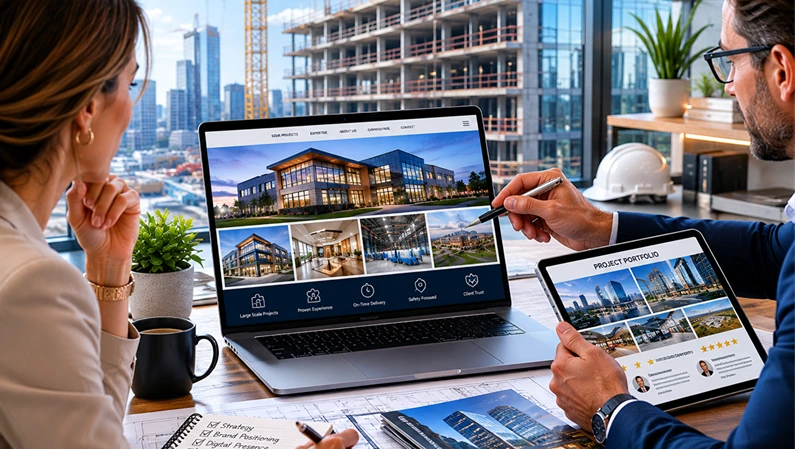
Winning a multi-million dollar construction contract begins long before the proposal is submitted. It begins the moment a developer, institutional buyer, or owner’s representative searches for a contractor online and starts forming judgments based on what they find. For high-stakes projects, digital credibility is not a marketing advantage; it is a procurement requirement that determines whether a contractor is considered at all.
What Digital Credibility Means in High-Value Construction
The Threshold Every Contractor Must Clear
High-value construction clients are not casual buyers. They are experienced professionals managing significant financial risk, and they conduct thorough due diligence before shortlisting anyone. Digital credibility is the threshold a contractor must clear in that due diligence phase, the point at which the client determines that your company is worth a conversation.
A contractor that clears this threshold presents a professional, current, evidence-rich digital presence that answers the client’s core questions without requiring them to pick up the phone first. A contractor that does not clear it gets filtered out silently, often without ever knowing the opportunity existed.
Why the Stakes Change the Standard
A client procuring a $2 million tenant improvement project and a client procuring a $40 million ground-up development are both conducting research online, but the depth and rigor of that research differ substantially. For multi-million dollar construction projects, clients scrutinize the contractor’s digital presence with far more care, looking for any signal that the company may not be capable, stable, or credible at the required scale.
This means that the digital credibility standard for high-value construction work is considerably higher than for smaller projects. A basic website with a few project photos and a phone number will not pass the scrutiny of a sophisticated institutional buyer or a developer with a $30 million budget on the line.
The Pillars of Digital Credibility for High-Value Construction
A Website That Communicates Scale and Competence
The contractor website is the first and most heavily weighted piece of evidence in a client’s digital due diligence. For high-value projects, the website must communicate several things simultaneously: that the contractor has completed projects of comparable scale and type, that the organization has the management infrastructure to support complex projects, and that the company is financially and operationally stable.
Website design for high-value commercial contractors must be structured around the buyer’s evaluation criteria, not around internal preferences. That means leading with project evidence, making scale claims verifiable through specific documentation, and presenting the leadership team with enough biographical depth that a client can assess the experience behind the name on the company page.
Project Documentation That Goes Beyond a Photo Gallery
Digital credibility for multi-million dollar construction projects requires more than a collection of completed building photos. Clients evaluating high-value opportunities want to understand the context of each project: the scope, complexity, client type, schedule performance, and any notable challenges successfully managed.
Content writing for construction portfolio entries should describe each major project in specific, outcome-oriented language. The square footage matters less than the story: what was the project challenge, what did the contractor bring to solving it, and what did successful delivery mean for the client? Portfolio entries structured around this narrative deliver far more credibility than lists of project names and dimensions.
Third-Party Validation That No Marketing Copy Can Replace
For high-value projects, self-reported capability claims carry limited weight. What carries weight is evidence that others have evaluated your company and found it credible: client references from comparable projects, industry certifications and memberships, bonding and licensing documentation, safety performance records, and published case studies with verifiable outcomes.
Reputation management for commercial contractors should actively surface this third-party validation across every channel where potential clients conduct research: Google Business Profile, LinkedIn, industry directories, and any trade press coverage the company has earned. A contractor with strong third-party credibility signals in multiple locations is dramatically more persuasive than one whose only validation comes from their own website.
How Search Visibility Connects to Digital Credibility

Being Unfindable Is Its Own Credibility Problem
A contractor that does not appear in relevant search results for their market and project type sends an implicit signal that their digital presence is minimal. For high-value buyers who associate digital sophistication with organizational competence, a weak search presence can itself become a disqualifying factor.
National SEO for commercial contractors serving regional or national markets must target the specific search terms that developers and institutional buyers use when researching contractors for large projects. Generic contractor terms generate traffic; sector-specific and project-type-specific terms generate qualified prospects who are actively evaluating vendors for high-value work.
Content That Demonstrates Expertise, Not Just Activity
Publishing content on a construction company blog is only valuable if that content demonstrates genuine expertise on topics relevant to the buyer’s decision. An article that explains how a contractor manages design-build coordination for complex, phased projects demonstrates expertise. A generic post about “the importance of safety on job sites” demonstrates activity without expertise.
Content writing for high-value construction marketing should target the specific questions and concerns that developers and institutional buyers have during the research and evaluation phase. This kind of content builds authority in search results while simultaneously delivering value to the exact audience most likely to commission high-value work.
Building Digital Credibility Across Every Touch Point

LinkedIn as a Credibility Channel
LinkedIn is the most commonly used professional research platform by buyers of high-value construction services. Developers, project managers, architects, and institutional procurement professionals spend significant time on LinkedIn, using it to evaluate contractors, review project announcements, and assess the professional depth of a firm’s leadership.
Social media management for commercial contractors should treat LinkedIn as a primary channel for credibility. Regular project milestone announcements, team member spotlights, and thought leadership content from company principals build a visible record of organizational activity and expertise that a buyer reviewing your LinkedIn profile before a meeting will use to form impressions.
Consistency Across All Digital Channels
Digital credibility for multi-million dollar construction projects requires consistency across every channel where a client might encounter your company. The business name, address, and contact information must match across your website, Google Business Profile, LinkedIn, and any industry directories where your company appears. Inconsistencies in basic information raise questions about operational attention to detail, which translates directly into questions about job site attention to detail.
Onsite SEO that includes structured data markup for your business and project content helps ensure that search engines and the buyers using them receive consistent, accurate information about your company across every search context.
The Proposal as a Digital Credibility Extension
Digital credibility does not end when a client moves to the proposal phase. Proposals that incorporate well-documented portfolio evidence, professional project photography, and verifiable client references extend the credibility built through your digital presence into the formal selection process. A proposal that feels consistent with a strong digital presence reinforces the buyer’s confidence; one that feels disconnected from it raises questions about what is real and what is curated.
Frequently Asked Questions About Digital Credibility for Multi-Million Dollar Construction Projects
How long does it take to build meaningful digital credibility for high-value construction work?
Building a credible digital presence for high-value construction markets typically takes 6 to 18 months of consistent investment, depending on the starting point. SEO improvements become measurable within 3 to 6 months. Portfolio and content depth builds over time as projects are documented and published. Reputation signals accumulate with each client reference and review collected. The most important factor is starting systematically rather than waiting for a perfect moment.
What is the single most important element of digital credibility for a commercial contractor?
The portfolio is the most influential single element because it provides direct, verifiable evidence of relevant experience. However, portfolio strength is most effective when supported by credible third-party validation, such as client references, reviews, and bonding documentation. No single element substitutes for a comprehensive, consistent digital presence that answers every question a sophisticated buyer might have.
Does company size affect how digital credibility should be built?
Yes. Smaller firms competing for high-value projects need to communicate that their organizational depth and subcontractor relationships compensate for lower headcount. Larger firms need to demonstrate that size has not reduced responsiveness or senior leadership involvement in project delivery. The credibility story is different, but the need for a credible, evidence-rich digital presence is identical regardless of company size.
How do online reviews factor into high-value construction procurement?
Online reviews carry less weight in high-value construction procurement than in consumer purchasing, but they are not irrelevant. A pattern of negative reviews or an absence of any reviews raises questions during the due diligence phase. Positive, specific reviews from identifiable client contacts provide meaningful third-party validation, particularly on Google Business Profile and LinkedIn.
Should commercial contractors invest in paid advertising to build digital credibility?
Paid social ads on LinkedIn can build brand awareness among a targeted audience of developers and institutional buyers, accelerating the credibility-building process by keeping your company visible to the right audience between active project searches. Paid advertising supports credibility building but does not replace the organic evidence, portfolio depth, and reputation signals that sophisticated buyers ultimately rely on.
Turn Your Completed Projects Into a Digital Credibility Machine
Commercial contractors that invest in building a comprehensive, evidence-rich digital presence consistently win higher-value opportunities than those relying on referrals and relationships alone. Digital credibility for multi-million dollar construction projects is not a one-time task; it is an ongoing system that compounds over time. LeadOrigin builds full-service digital marketing strategies for construction and B2B companies, turning real project experience into consistent, high-value lead generation.Contact our team to build the digital credibility your firm needs to win at the level your work deserves.