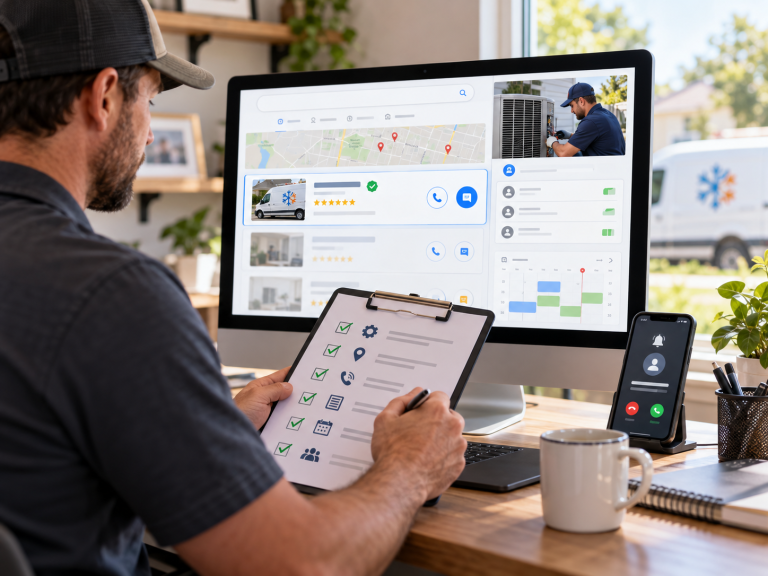

Commercial real estate is inherently local. Tenants lease space in a specific corridor, investors buy in specific submarkets, and owners hire brokers who know their part of town. Local SEO for commercial real estate gives your firm visibility when decision-makers search, and most brokerages still leave that opportunity wide open.
Why Local Search Works Differently in Commercial Real Estate
Residential real estate generates huge search volume. Commercial search is smaller, more specific, and far more valuable per lead. A single search for “industrial broker in [city]” or “office tenant representation [city]” can come from a company about to sign a multi-year lease or a landlord choosing who will fill an entire building.
Those searches often trigger the local pack, the map results at the top of Google. A firm that appears there, with strong reviews and a complete profile, gets seen before any organic listing. A firm that does not appear often never enters the conversation, no matter how strong its track record.
Competition is also lighter than it looks. Many commercial brokerages still treat their website as a digital brochure and rely on referrals and portals. Firms that invest in local SEO for commercial real estate can win ground quickly, especially in secondary markets and specialized property niches.
Local SEO for Commercial Real Estate: Opportunities Most Firms Miss
A Fully Built Google Business Profile for Every Office
Your Google Business Profile is often the first thing prospects see. Choose the most accurate primary category, such as a commercial real estate agency, and add secondary categories that reflect your services. Fill in the business description, service areas, hours, and services list in detail, including tenant representation, landlord representation, investment sales, and property management if you offer them.
Most CRE firms stop there. The opportunity is to keep the profile active: post notable leases and sales, add current photos of your team and office, and share market updates. Each firm location with staff who meet clients in person should have its own profile.
Individual buildings can sometimes qualify too. A property with a staffed on-site leasing or management office may be eligible for its own profile. Review Google’s guidelines before creating one, since profiles for unstaffed properties or virtual offices risk suspension.
Submarket and City Pages
Local rankings depend on your website as much as your profile. Build a dedicated page for each city and major submarket you serve, and give each one real substance: the property types your team handles there, recent activity, key corridors, and the brokers who cover that area.
Avoid duplicating the same page with a different city name swapped in. Search engines recognize thin, templated location pages, and prospects do too. A page that reads like a local expert wrote it will outperform ten copies that do not.
Broker Profile Pages With Local Focus
Clients choose brokers, not just firms. Give each broker a detailed profile page that lists the submarkets and property types they specialize in, notable transactions, professional designations such as CCIM or SIOR, and community involvement. These pages rank for broker name searches and reinforce your firm’s local expertise.
Citations and Industry Directories
Consistent business listings across the web help search engines trust your location data. Make sure your firm name, address, and phone number match exactly on major directories, your listing portals, the local chamber of commerce, and professional association directories. Chapters of commercial real estate associations and local economic development organizations are often overlooked sources of relevant, trusted listings.
Reviews From Commercial Clients
Reviews influence both local rankings and client trust, but commercial firms rarely ask for them. B2B clients are generally willing to leave a short review after a successful lease or sale, especially when the request is personal and easy. Ask at the close of each transaction, make the link simple, and respond to every review professionally. A structured review management process keeps requests consistent across your team.
Local Links and Media Mentions
Links from respected local sources are among the strongest local ranking signals. Commercial firms have natural advantages here. Local business journals regularly quote brokers on market conditions, economic development groups share market data, and community sponsorships often include a link. Publishing original market data gives reporters a reason to cite your firm. A focused public relations effort turns that expertise into steady local coverage and links.
Local Content That Answers Real Questions
Content tied to your market attracts searches that generic pages cannot. Quarterly submarket reports, guides to leasing in a specific district, explainers on local zoning changes, and spotlights on growing corridors all position your firm as the local authority. They also give your brokers something valuable to share with prospects.
Location Signals on Every Listing
Your listings are local content too. Each listing page should state the neighborhood, submarket, and nearby landmarks or corridors in plain text, and link to the matching submarket page. An embedded map and clear directions help visitors, while the text helps search engines connect the property to the area it serves.
Listings also strengthen your submarket pages over time. When a submarket page links to several active listings and a record of past deals, it shows real activity in that area. That combination of local content, live inventory, and transaction history is hard for competitors without a local presence to match.
Local Events and Community Involvement
Commercial real estate runs on relationships, and much of that happens in person. Hosting a market outlook breakfast, speaking at a chamber event, or sponsoring a local business award creates content for your website and Google Business Profile, earns mentions on event and partner sites, and puts your brokers in front of the owners and tenants they want to meet. Document each event with a short recap page and photos so the effort keeps working in search long after the day itself.
Common Local SEO Mistakes in Commercial Real Estate
The most frequent problem is inconsistent location data. Firms that have moved offices, merged, or rebranded often leave old addresses and phone numbers scattered across directories, confusing search engines and splitting ranking signals. Audit your listings and correct them before building anything new.
Another common mistake is using a single homepage to target every city the firm serves. One page cannot rank well for a dozen different markets. Keyword-stuffed profile names, fake office addresses, and purchased reviews are riskier still, since they can lead to profile suspensions that take months to recover from.
Running Local SEO Across Multiple Offices
Multi-office firms need structure. Each office should have its own Google Business Profile, its own location page on your website with the exact address shown on the profile, and its own set of local citations. Link each profile to its matching location page rather than your homepage.
Keep brand messaging consistent, but let each office reflect its market. An office serving an industrial-heavy region should highlight industrial expertise, while a downtown office may lead with office and retail. Local SEO for commercial real estate works best when every location reads as a genuine local expert, not a branch of a distant firm.
Local Visibility in AI Search
More decision-makers now ask AI tools questions like “who are the top industrial brokers in Dallas” or “what is the office vacancy rate in Austin.” These tools draw on sources they can verify: consistent business listings, reviews, local media mentions, and clear, well-organized website content.
The same work that strengthens local rankings improves your chances of being named in those answers. Accurate profiles, detailed broker pages, and dated market data give AI systems more to work with. Building your content with generative engine optimization in mind helps your firm appear in both traditional and AI-driven search.
Measuring Local SEO Results
Track your Google Business Profile performance, including profile views, website clicks, calls, and direction requests. Monitor rankings for your key service and location searches across the areas you serve, since local results change from one part of a city to another.
Connect those numbers to business outcomes. Record where each new inquiry came from, whether a profile call, a location page form, or a broker page. Over time, the data shows which offices, submarkets, and services benefit most from local visibility, and where to invest next. Strong local SEO for commercial real estate should lead to more qualified conversations with tenants, owners, and investors, backed by a sound local SEO strategy for every market you serve.
Local SEO for Commercial Real Estate: Frequently Raised Questions
Do commercial real estate firms need a Google Business Profile?
Yes. Many commercial searches trigger map results, and a complete, active profile is how your firm appears there. Each office where staff meets clients should have its own profile.
Can an individual commercial property have its own Google Business Profile?
Sometimes. A property with a staffed on-site leasing or management office may qualify. Check Google’s guidelines first, since profiles for unstaffed buildings or virtual offices can be suspended.
How do commercial firms get more reviews?
Ask at the close of each successful transaction, keep the request personal, and send a direct link. Most satisfied B2B clients are willing to help when the process is quick.
Are city pages worth building if we serve many markets?
Yes, as long as each page has real local substance. Pages that simply swap city names rarely rank. Focus first on the markets where you do the most business, then expand.
How long does local SEO take to show results?
Profile and citation improvements can affect local rankings within weeks. Content, reviews, and local links build over several months, with the strongest gains coming from consistent effort across a year.

Owning Local Search in Your Commercial Market
The commercial firms that win local search are not always the biggest. They have complete profiles, genuine local content, steady reviews, and a reputation that shows up across the web. LeadOrigin is an award-winning agency serving businesses across Texas and nationwide, and we help commercial real estate firms turn local expertise into local visibility. Contact our team to find the local search opportunities in your market.