
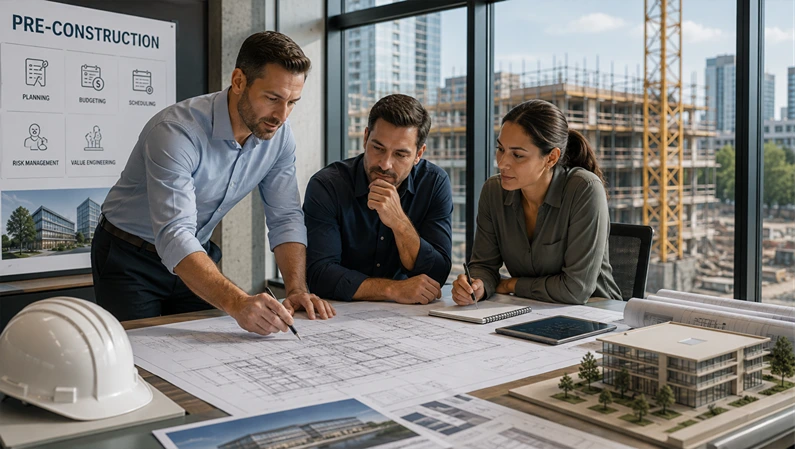
Most commercial contractors market their finished buildings. Few market what they did before ground was broken. This is a significant missed opportunity, because for developers and sophisticated owners, a contractor’s pre-construction capabilities are often more decisive in the selection process than the quality of their completed work. Pre-construction expertise is where value is created and risk is managed, and contractors that communicate this clearly win better projects at higher margins.
What Pre-Construction Expertise Actually Covers

The Phase That Determines Project Outcomes
Pre-construction is the planning and analysis phase that occurs before a single cubic yard of concrete is poured. It encompasses preconstruction estimating, constructability reviews, value engineering, scheduling analysis, subcontractor pre-qualification, permitting strategy, and design coordination. Done well, pre-construction surfaces problems while they are still cheap to solve, rather than after they have become expensive field conditions.
Contractors with genuine pre-construction expertise deliver a measurable advantage to their clients: more accurate budgets, fewer change orders, faster permitting timelines, and a project that arrives at groundbreaking with fewer unknowns. This is the kind of value that sophisticated developers and institutional owners actively seek and are willing to pay for.
Why Most Contractors Undermarket This Phase
Pre-construction work is less visually compelling than a completed building, which is part of why it goes undermarketed. There are no dramatic photographs of a constructability review meeting. The value of an accurate preliminary estimate is not immediately visible the way a finished facade is. As a result, most contractors default to portfolio-heavy marketing that shows outcomes without explaining the process that produced them.
This creates an opportunity. Contractors that invest in communicating their pre-construction expertise differentiate themselves from competitors who lead with the same polished project photos. In a market where finished building imagery looks similar across firms, the depth and sophistication of the pre-construction process becomes a meaningful competitive separator.
Why Pre-Construction Expertise Matters to Developers
The Risk That Developers Are Managing
A developer entering a major construction project is managing a complex set of financial, schedule, and reputational risks. Cost overruns threaten project returns. Schedule delays disrupt tenant commitments and financing terms. Design coordination failures create change orders that erode margins. The developer’s primary interest in selecting a general contractor is identifying the firm most likely to minimize these risks.
Pre-construction expertise speaks directly to this concern. A contractor that can demonstrate a rigorous preconstruction process, supported by documented case studies showing how early-phase analysis reduced costs or compressed schedules on comparable projects, is offering the developer exactly what they value most: risk reduction backed by evidence.
Content writing for commercial contractors should include case studies that trace the connection between pre-construction decisions and project outcomes. A case study that explains how a value engineering exercise during design development saved a client $800,000 without compromising design intent is more persuasive to a developer than a portfolio entry showing a completed building, because it demonstrates the thinking behind the work, not just the work itself.
The Selection Criteria That Rarely Appear in RFPs
Developers and owners often evaluate pre-construction capabilities through informal assessments before a formal RFP is issued. They ask peers about their experience with contractors during the preconstruction phase. They look for evidence of estimating depth, scheduling sophistication, and design coordination capability in capability statements and proposals. They ask questions in interviews specifically designed to surface the quality of a contractor’s preconstruction thinking.
Contractors whose marketing addresses these informal evaluation criteria through detailed website content, case studies, and team bio pages that highlight preconstruction-specific experience are better positioned to make a strong impression before the formal process begins.
How to Market Pre-Construction Expertise Effectively
Feature the Pre-Construction Team
Pre-construction expertise lives in people as much as in process. The estimating team, preconstruction manager, and design coordination leads are the professionals whose capability most directly determines the quality of a contractor’s preconstruction work. These individuals should be featured on the company website with biographical information that specifically highlights their preconstruction experience and relevant project history.
Website design for commercial contractors should include a dedicated team section that presents preconstruction professionals alongside project executives and field leadership. Developers who do their homework before reaching out want to know who will be working on their project, and the preconstruction team is often the first group they want to evaluate.

Create Dedicated Pre-Construction Content
A dedicated pre-construction services page on your website is the most direct way to communicate this expertise to developers conducting research. The page should describe your preconstruction process in detail: how estimates are developed, what the constructability review involves, how value engineering is approached, and what clients can expect in terms of deliverables and communication during the preconstruction phase.
Onsite SEO for this page should target terms that developers use when searching for contractors with strong preconstruction capabilities: “design-build preconstruction services,” “commercial construction estimating,” “constructability review,” and similar phrases. Ranking for these terms positions the contractor in front of clients who are actively evaluating preconstruction capability as a selection criterion.
Use LinkedIn to Demonstrate Preconstruction Thinking
LinkedIn is the most effective social platform for communicating pre-construction expertise to a developer audience. Posts that walk through a value engineering decision, explain how a scheduling challenge was resolved during preconstruction, or describe how a phased occupancy strategy was developed in the preconstruction phase demonstrate the kind of thinking that differentiates a sophisticated contractor from a capable but undifferentiated one.
Social media management for commercial contractors should include a regular cadence of preconstruction thought-leadership content, positioned as practical insights rather than promotional material. Developers who engage with this content form an impression of the contractor’s intellectual depth that influences their decisions when an active project opportunity arises.
Connecting Pre-Construction Marketing to Business Development
Pre-Construction as a Lead Generation Tool
Offering a preliminary preconstruction consultation or budget review as a structured service, with a defined scope and clear deliverables, is a lead-generation strategy that simultaneously demonstrates capability and creates a working relationship with a prospective client. Developers who receive a well-executed preliminary estimate from a contractor they have not previously worked with are substantially more likely to include that contractor in their next formal process.
Paid social ads targeting developers and commercial real estate professionals can promote this consultation offer directly to the audience most likely to benefit. A targeted LinkedIn campaign featuring a preconstruction consultation offer with a specific value proposition, such as a preliminary budget and schedule assessment for your next commercial project, generates qualified leads from prospects who are already in the planning phase.
How Pre-Construction Content Builds Long-Term SEO Authority
Pre-construction expertise content is not consumed once and forgotten. Developers research contractors across multiple sessions before making decisions, and content that demonstrates technical depth builds authority over time. A library of preconstruction case studies, educational articles, and process documentation creates a compounding SEO asset that continuously attracts qualified traffic.
National SEO for commercial contractors benefits significantly from preconstruction-specific content, as it targets a narrower, higher-intent audience. A developer searching for “design-build preconstruction services Texas” is further along in their evaluation process than one searching for “commercial contractor Texas,” and content that speaks directly to that specific search intent converts at a higher rate.
Frequently Asked Questions About Pre-Construction Expertise in Marketing
Why don’t more commercial contractors highlight pre-construction in their marketing?
The most common reason is that pre-construction work is less visually demonstrable than completed projects. Without strong photography or video, contractors default to showing finished buildings. However, pre-construction expertise can be communicated effectively through case studies, process descriptions, team biopages, and educational content that walks through preconstruction decision-making, none of which require dramatic imagery to be compelling.
What types of clients respond most strongly to pre-construction expertise marketing?
Repeat developers, institutional owners, and clients managing complex or phased projects respond most strongly to pre-construction expertise marketing because they have experienced firsthand the cost and schedule consequences of weak preconstruction work on previous projects. These are also typically the clients with the highest project values and the strongest preference for long-term contractor relationships, making them high-priority targets for contractors with genuine preconstruction capability.
How detailed should pre-construction content be on a contractor’s website?
Detailed enough to be credible, but not so technical that it becomes inaccessible to a developer who is not a construction professional. The goal is to demonstrate sophistication and process rigor without requiring a reader to have estimating experience to understand the value being described. Explain what the preconstruction process produces for the client in terms of outcomes: more accurate budgets, fewer surprises, faster permitting, and a project that arrives at groundbreaking with alignment across all stakeholders.
Can smaller contractors compete on pre-construction expertise?
Yes. Pre-construction capability is a function of the quality of the estimating and project planning team, not the size of the organization. A smaller contractor with a seasoned preconstruction manager and a rigorous process can outcompete a larger firm with a less disciplined approach. The key is to make that capability visible through marketing that specifically addresses preconstruction, rather than leading with project scale and volume alone.
Should pre-construction services be priced separately or included in the general contract?
This varies by project type and client relationship, but structuring preconstruction as a defined, compensable scope of work signals professionalism and protects the contractor’s investment in detailed early-phase analysis. Developers who pay for preconstruction services are also more committed to the process and more likely to continue with the same contractor into the construction phase. This structure reinforces the marketing message that preconstruction expertise has genuine, quantifiable value.
Market Your Pre-Construction Expertise and Win Smarter Projects
Contractors that lead with pre-construction expertise attract clients who understand and value that expertise, resulting in better project relationships, fewer disputes, and stronger margins. The developers and institutional owners most worth working with are actively looking for partners who can reduce their risk before ground is broken. LeadOrigin builds marketing systems for construction and B2B service companies that communicate the right capabilities to the right clients. Contact us to build a pre-construction marketing strategy that attracts the projects your firm is best positioned to deliver.