
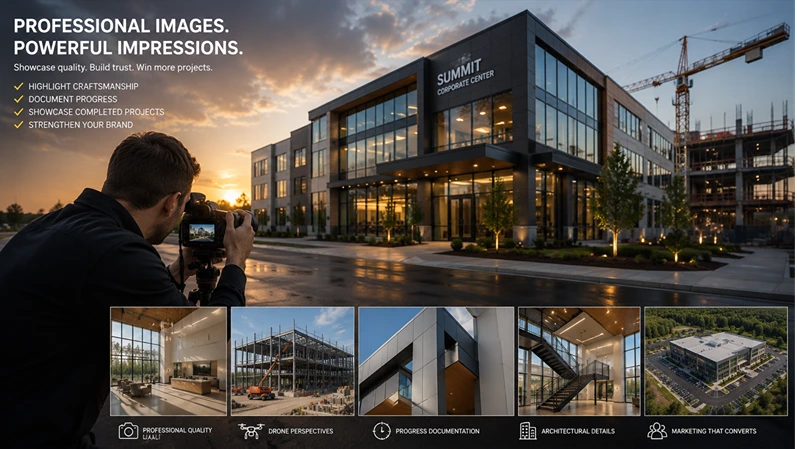
A developer evaluating commercial contractors for a major project forms an impression within seconds of landing on a portfolio page. That impression is built almost entirely on images. Project photography is not a cosmetic addition to a commercial construction website; it is the primary evidence that a contractor has performed the work claimed, at the scale implied, and to the quality promised.
Why Images Carry More Weight Than Words in Construction Marketing
The Proof Problem in Commercial Construction
Commercial construction marketing has a fundamental credibility challenge: every contractor claims quality, experience, and reliability. No contractor claims to deliver late, run over budget, or produce substandard work. When all marketing language says the same thing, buyers default to visual evidence to make distinctions.
Project photography solves the proof problem by providing something that claims cannot: verifiable, specific, visual documentation that a project was completed. A developer who sees a well-photographed portfolio of projects similar to theirs does not need to take your word for your capabilities. The work speaks directly.
Photography as a Sales Tool Before a Conversation Starts
Much of the evaluation process that precedes an RFP happens without any contact between the developer and the contractor. Developers review websites, compare portfolios, and form strong preferences based on what they find, all before picking up the phone. Project photography that is well-executed and strategically organized does sales work continuously, in every research session by every prospect who visits your site.
Website design that puts project photography front and center in the navigation experience, rather than burying it on a secondary gallery page, ensures this visual proof is encountered early on every visit. Structure matters as much as quality.
What Separates Professional Project Photography from Amateur Documentation
Lighting, Angle, and Timing
Professional construction photography requires skills that go beyond pointing a camera at a finished building. Exterior photography depends heavily on lighting conditions: golden hour shots that capture the building in warm, natural light convey quality differently than flat midday shots. Interior photography requires an understanding of how to balance natural and artificial light without washing out materials or losing depth.
Angle selection matters just as much. Photographs taken at eye level from a street often fail to communicate the scale and presence of a commercial project. Low angles that emphasize height, wide shots that capture context, and detail shots that highlight material quality together create a complete picture that a single image cannot deliver.
Timing is the third variable. Projects should be photographed at completion, after landscaping is in place and the site is clean, not during the punch list. For phased projects, milestone photography documents progress and creates a timeline narrative for marketing.
The Difference Between Documentation and Marketing
Construction documentation photography serves the project record. Marketing photography serves the next client. These are not the same thing, and treating documentation photos as marketing assets is one of the most common mistakes commercial contractors make.
Documentation photos capture what exists. Marketing photos communicate what is impressive about what exists. A marketing photographer knows to remove temporary signage, ensure vehicles are positioned or removed strategically, time shots to exclude construction debris still present at nearby phases, and select framing that isolates the project from unflattering surroundings.
Content writing that accompanies marketing photography should describe what made the project notable: the complexity of the site, the schedule compressed to meet a tenant opening date, and the structural challenge resolved through a design-build collaboration. Photography and written context together produce a portfolio entry that is far more persuasive than either element alone.
How Project Photography Supports Your Broader Digital Strategy

SEO Value of Image-Rich Portfolio Pages
Portfolio pages with high-quality photography, properly tagged with descriptive file names and alt text, contribute to search visibility. Image search is a significant traffic source for commercial construction companies, particularly for developers seeking visual references for specific project types. A portfolio page for a completed medical office building, with a dozen well-tagged project photos, generates image search visibility that a text-only page cannot.
Onsite SEO for commercial contractors must address image optimization as a core component. File names should describe the project type, location, and contractor name. Alt text should describe the image content with relevant keywords. Page load performance should be monitored to ensure that high-resolution photography does not degrade the browsing experience.
Social Media and Platform Distribution
LinkedIn is the primary social platform for commercial construction marketing, and project photography performs well there. A post featuring three or four strong exterior and interior shots of a completed project, with a brief description of the scope and client outcome, generates meaningful engagement among developers, architects, and commercial real estate professionals.
Social media management for contractors should build a consistent cadence of project photography posts, milestone shots, and behind-the-scenes construction progress content. This keeps the company visible to the developer audience between project completions and builds a visual archive of work that prospects can browse.
Proposal and Pitch Support
Project photography does not only live online. High-quality images should appear in every proposal, capability statement, and pitch deck a contractor produces. Developers evaluating a proposal that includes professional project photography alongside scope and pricing have a materially different experience than those reviewing a text-heavy document with stock imagery.
The investment in professional photography pays across every channel where the contractor presents itself: website, social media, proposals, email campaigns, and trade press.
Building a Project Photography Program

Establish a Photography Budget Per Project
Rather than treating project photography as an ad hoc expense on select projects, commercial contractors should establish a standard photography budget applied to every project above a defined value threshold. A consistent program ensures that the portfolio grows systematically rather than in unpredictable gaps.
A single professional construction photography session typically ranges from several hundred to a few thousand dollars, depending on project size, location, and photographer experience. Against the contract value of a commercial project and the long-term marketing value of the images produced, this is a consistently high-return investment.
Build a Shot List Before Every Session
Every project photography session should be planned with a shot list developed in collaboration with the photographer. The list should include exterior establishing shots from multiple angles, interior shots of key spaces, detail shots of notable materials or features, and any project elements that demonstrate technical complexity or scope. A planned session produces more complete and useful marketing assets than an unstructured walk-through.
Frequently Asked Questions About Project Photography in Commercial Construction Marketing
How much should a commercial contractor budget for project photography?
The budget depends on the project’s size and scope, but a professional construction photography session for a mid-size commercial project typically costs between $800 and $3,000. For major projects, drone photography and aerial shots add value and may increase cost. Throughout the marketing life of the images, the per-use cost is minimal relative to the impression they create.
Should contractors use drone photography for commercial projects?
Drone photography is highly effective for large footprint projects, campus developments, and projects where the relationship between the building and its site context is significant. Aerial shots communicate scale in a way that ground-level photography cannot. For urban infill projects or smaller buildings, drone photography may add less value than strong ground-level and interior work.
How often should a commercial contractor update its portfolio photography?
New projects should be photographed at completion on an ongoing basis. Older projects documented with lower-quality photography can be re-shot if the building is still accessible and the images remain relevant to current marketing efforts. A portfolio that reflects only projects from five or more years ago may fail to communicate current capability and scale.
Can smartphone photography substitute for professional photography on smaller projects?
For social media behind-the-scenes content and construction progress updates, smartphone photography is acceptable. For portfolio pages, proposals, and any formal marketing materials, professional photography is non-negotiable. The quality differential is visible immediately to a developer who has reviewed multiple contractor portfolios and associates image quality with company quality.
How should project photography be organized on a contractor website?
Organize portfolio photography by project type, building category, or vertical served, not by chronological date. A developer looking for healthcare construction experience should be able to navigate directly to that category and see relevant projects immediately. Filtering by project size or value is an additional feature that serves sophisticated buyers evaluating scale-appropriate experience.
Make Project Photography the Competitive Edge That Fills Your Pipeline
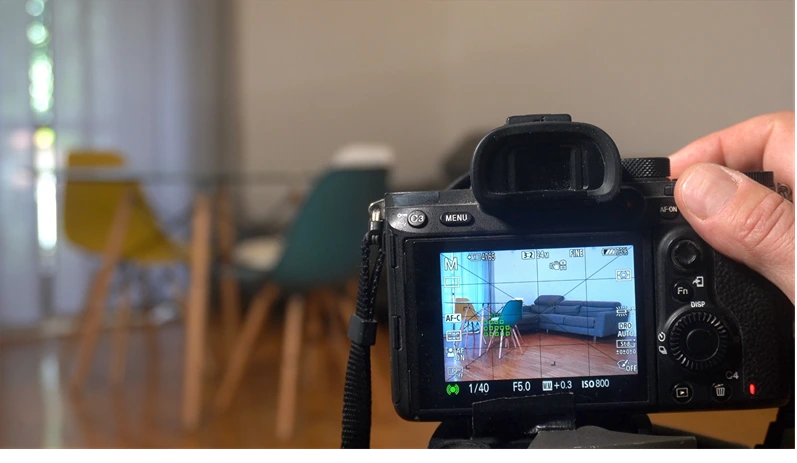
Commercial contractors that invest in professional project photography consistently outperform those that rely on documentation images and word-of-mouth credibility in the digital research phase. The images you produce today will represent your company in developer research sessions for years. LeadOrigin helps construction and B2B companies build marketing systems that turn completed work into continuous lead generation. Contact us to build a project photography and portfolio strategy that helps you win more contracts.