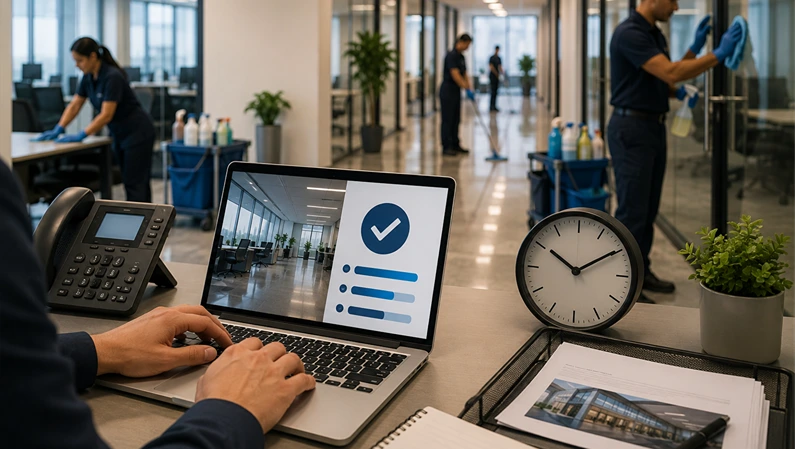
A facility manager submits a quote request on your website at 2:15 PM. By 2:45 PM, they have submitted the same request to two competitors. If your response arrives at 4:30 PM, you are already in a weaker position than the company that called back at 2:30 PM. In commercial cleaning, response time to quote requests is not a courtesy issue. It is a competitive differentiator that directly affects the close rate.
Why Speed of Response Changes the Sales Outcome

First Contact Establishes Framing Advantage
The company that reaches a prospect first gets to ask the questions, frame the conversation, and establish rapport before the competition has even acknowledged the lead. This first-mover advantage compounds throughout the sales process: the first vendor to submit a proposal, the first to follow up after the walk-through, and the first to address objections typically wins.
Research across B2B sales consistently shows that response time within the first five minutes of a lead submission dramatically increases the probability of conversion. Waiting 24 hours, which is still common practice among many commercial cleaning companies, forfeits this advantage entirely.
Prospects Interpret Slow Response as an Operations Signal
A facility manager evaluating a commercial cleaning vendor is implicitly asking: if they take three days to call me back when they want my business, how responsive will they be when I have a service issue? A slow response to a quote request signals a slow response to complaints, emergencies, and service failures.
Fast response, conversely, sets a strong precedent. It communicates organizational competence and signals that the company is operationally capable of delivering reliable service, not just winning contracts.
Building a Faster Response System
Automate the First Touch
The fastest response a commercial cleaning company can send is an automated one. When a prospect submits a quote request, an immediate automated confirmation that acknowledges receipt, sets an expectation for follow-up timing, and provides the prospect with a direct contact number creates instant engagement.
This automated first touch should be built into your website’s contact form workflow. Website development that integrates your form submissions with a CRM and email automation platform ensures no lead sits in an inbox waiting for someone to notice it.
Route Leads to the Right Person Immediately
Quote requests that land in a general inbox and wait for someone to forward them to the right sales contact lose time at every handoff. Build a lead-routing system that sends inbound commercial quote requests directly to the commercial sales lead, with a mobile notification that prompts an immediate call.
If your team uses AI chatbot technology on your website, it can begin qualifying the lead immediately: asking for facility size, service frequency preferences, and timeline. By the time a human follows up, the conversation is already underway.
Define and Enforce a Response Time Standard
Set an internal standard for commercial quote response time and measure against it. A realistic and competitive standard for business-hours submissions is a return call within 30 minutes. For after-hours submissions, the standard should be a first-thing follow-up the next business morning.
Share this standard in your marketing. “We respond to every commercial quote request within 30 minutes during business hours” is a specific, credible claim that sets you apart from competitors who make no such commitment.
How Response Time Affects Your Marketing ROI

Paid Ad Spend Depends on Fast Follow-Up
If your paid search ads budget is generating 40 quote requests per month and your team is responding to them in 24 to 48 hours, a significant portion of that ad spend is producing leads that convert far below their potential. Improving response time is the single fastest way to increase the return on your existing marketing investment without increasing spend.
The formula is straightforward: faster response increases close rate on existing lead volume, which increases revenue per dollar spent on acquisition.
Local SEO Drives Inbound Requests That Expect Immediacy
Prospects who find your company through a Google search and submit a quote request from your website or Google Business Profile listing are already in active selection mode. They are not browsing; they are evaluating. These high-intent leads have the shortest patience for slow follow-up.
A strong local SEO strategy that drives high-quality inbound requests must be matched with an equally strong response infrastructure to fully realize the value of that organic traffic.
Review Generation Depends on the Full Experience
Fast response not only closes more contracts; it also generates better reviews. Clients who note in their testimonials that your team was “immediately responsive” create social proof that attracts more leads who value responsiveness. This virtuous cycle connects review management directly to acquisition outcomes.
Frequently Asked Questions About Response Time In Commercial Cleaning Quote Requests
What is an acceptable response time for a commercial cleaning quote request?
For business-hours submissions, the industry-competitive standard is a return contact within 30 to 60 minutes. Anything beyond two hours during business hours carries a statistically measurable drop in conversion probability. After-hours submissions should receive a follow-up at the start of the next business day, ideally before 9 AM.
Should response time standards be different for large contracts versus small ones?
Prioritization based on contract size is reasonable for operations management, but the initial acknowledgment should always be fast, regardless of contract size. Large-contract leads are the most time-sensitive because these prospects typically compare multiple vendors simultaneously and move quickly.
Can automation fully replace human follow-up for commercial quote requests?
No. Automation handles the immediate acknowledgment and initial qualification effectively, but commercial cleaning contracts require human conversation for accurate scoping and trust-building. Use automation to ensure no lead goes unacknowledged, then follow with a personal call as quickly as possible.
How do you measure response time performance across a sales team?
CRM platforms with lead timestamp tracking allow you to measure time-to-first-contact for every inbound lead. Set weekly reporting on this metric and hold sales team members accountable to the standard. Without measurement, response time improvement goals are aspirational rather than operational.
Does response time matter for existing clients requesting service changes?
Yes. Existing clients who submit service change requests or complaints and receive slow responses are at elevated churn risk. Build the same response time standards into your client service operations as you apply to new lead follow-up.
The Fastest Way to Win More Contracts: Fix Your Response Time on Quote Requests
Response time for commercial cleaning quote requests is a controllable variable that directly and measurably affects close rate, revenue per lead, and long-term client retention. The companies that invest in the systems, automation, and culture required to respond faster win a disproportionate share of the contracts in their market.
LeadOrigin helps service businesses build the digital infrastructure and lead management systems that turn faster response into compounding revenue growth. Contact us to build a lead response system that closes more commercial cleaning contracts.