Restoration marketing is how water, fire, and mold damage companies capture emergency demand: local search visibility, service-specific pages, paid campaigns that scale during storms, review volume, and referral relationships. Because the buying window is minutes rather than weeks, being findable and answering immediately matters more than brand polish.
That is the whole category in one paragraph, and it explains why marketing built for a considered purchase fails here. The homeowner is not comparing five companies. They are trying to make the water stop.
How often does water, fire, and mold damage actually happen?
Water damage is common, fire is rare but severe, and both are frequent enough to support steady demand in any metro. The frequency numbers matter for marketing because they tell you where volume lives and where the high-ticket work lives.
According to the Insurance Information Institute, about one in 60 insured homes files a property damage claim caused by water damage or freezing each year, while about one in 425 files a claim related to fire and lightning. Roughly one in 18 insured homes has a claim of any kind annually.
The ratio is the takeaway. Water damage generates roughly seven times the claim frequency of fire, which is why water searches carry the volume and fire searches carry the ticket size. A company funding both equally is misreading its own market. Note that the loss category the Institute uses for water damage and freezing includes mold damage where a policy covers it, which is part of why mold rarely appears as its own line in industry data despite being a distinct service.
Why does the 24 to 48 hour window change your marketing message?
Because science sets your urgency claim for you. Water damage becomes mold damage on a clock, and that clock is documented by a federal agency rather than by restoration marketing copy.
The US Environmental Protection Agency states that drying wet or damp materials within 24 to 48 hours after a leak or spill will in most cases prevent mold growth. That single guideline is the most useful fact a restoration company can put on a page.
It reframes the pitch away from generic 24/7 availability language, which every competitor also claims, and toward a specific, verifiable reason to call now. Most restoration marketing in this category repeats the same three promises: fast, certified, insurance approved. A cited drying window is one of the few claims a competitor cannot copy without simply agreeing with you. It also gives your mold pages a natural connection to your water pages, since a mold job is very often a water job that was not dried in time. Content built around that window converts better than urgency language, because it explains why the urgency exists.
How do homeowners find restoration companies now?
Through a search on a phone, usually a long and specific one, increasingly answered inside the search interface before any website loads. That shifts the goal from ranking a page to being the source the answer is built from.
The scale of that shift is documented. Google reported in June 2026 that AI Overviews had passed 2.5 billion monthly users and AI Mode had surpassed one billion, alongside new controls for how site content appears in those features.
Query length is what makes this relevant to restoration specifically. A Pew Research Center analysis of browsing data from 900 US adults in March 2025 found that 60% of searches beginning with question words produced an AI summary, and 53% of searches of ten words or more did, compared with just 8% of one- and two-word searches. A panicked homeowner typing a full sentence about a burst pipe in a finished basement is writing exactly that kind of query.
The practical response is to publish the specifics in crawlable text: what happens in the first hour, what equipment gets used, what the insurance process looks like, what drying actually involves. This is the core of generative engine optimization for the category, and it overlaps almost entirely with content that already converts human readers.

What does Google actually reward in Local Services Ads?
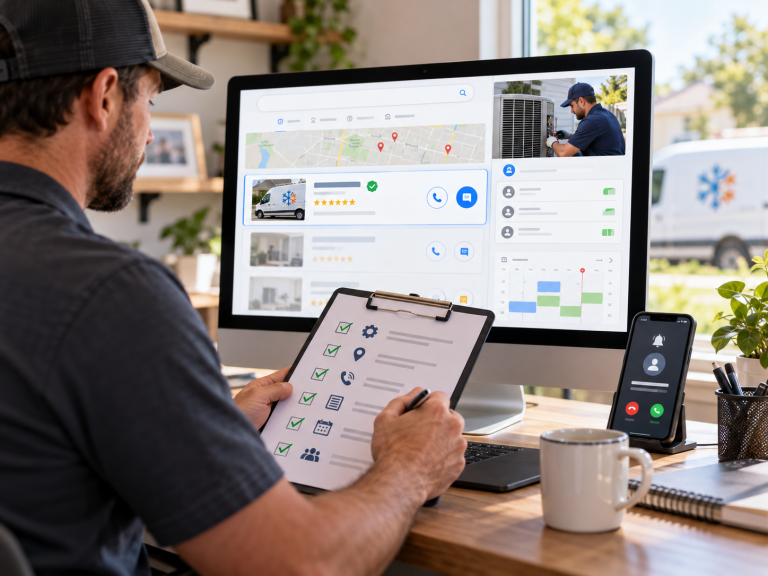
Answering the phone. Google’s own documentation names responsiveness as a ranking input, which means your operations directly affect your ad visibility, not just your close rate.
The Local Services ad rankings documentation states that ranking considers how likely your ad is to result in a lead, including your responsiveness to customer inquiries, and notes that missed calls may negatively affect that responsiveness. It also lists profile quality inputs including rating, number of reviews, average response time, and use of high-quality images, and it points out that enabling message and booking leads gives customers more ways to reach you during nights and weekends when the phone goes unanswered.
One process note worth correcting, because a lot of published advice is out of date: manual lead disputes are gone. Google now describes an automated lead credit system in which it identifies low-quality leads rather than requiring advertisers to file individual disputes, with credits unavailable in certain verticals and regions. Tight service areas and accurate job types now prevent bad leads instead of recovering their cost afterward.
Should you build separate pages for water, fire, and mold?
Yes. The three services have different search volumes, different urgency levels, and different buyer anxieties, and combining them onto one page means ranking well for none of them.
| Service | Relative claim frequency | Buyer state | Page should lead with |
| Water damage | About 1 in 60 insured homes annually | Acute panic, active damage | Response time, extraction and drying, the 24 to 48 hour window |
| Fire and smoke | About 1 in 425 insured homes annually | Displaced, longer timeline | Soot and odor removal, contents handling, carrier coordination |
| Mold remediation | Counted within water and freezing losses | Anxious, researching, not urgent | Testing, containment, health questions, what remediation involves |
Each service also earns location-level pages in the markets you dispatch to. A page targeting water damage restoration in a named city, written with real local detail about building stock and weather patterns, consistently outperforms one statewide page with a list of service areas. Strong local SEO underneath that structure means consistent business information across directories, accurate service categories, and a Google Business Profile that reflects genuine 24-hour availability.
How should a restoration marketing budget be allocated?
Across three jobs: being findable during an emergency, being scalable during a surge, and being credible before either happens. Most companies fund the first, underfund the second, and skip the third.
The findable layer is local search visibility and profile completeness, which capture demand that already exists. The scalable layer is paid search held in reserve for storm response, since emergency keywords are among the most expensive in home services and campaigns that cannot expand within hours leave the highest-value work to competitors. Disciplined paid search management here means aggressive negative keyword lists, overnight ad scheduling when competitors pause, and call tracking on every ad because the conversion is a phone call.
The credibility layer is reviews and referral relationships. Review volume does the evaluating when the buyer has no time to evaluate, which is why consistent review management built into job completion outperforms occasional review pushes. Referral partners including plumbers, adjusters, and property managers encounter the damage before the homeowner searches, and content written for those professionals both supports the relationship and captures their searches.
Underneath all three sits site performance. A page that takes six seconds to load on a damaged phone with one bar of signal loses the caller before your number renders. Click-to-call buttons that require scrolling cost jobs every single day, and no amount of media spend upstream compensates for it.
One allocation warning worth stating plainly: do not spend the storm reserve during quiet months because the budget is sitting there. The entire value of that reserve is its availability in the 48 hours when emergency search volume triples and every competitor’s bids spike at once. Companies that treat it as ordinary monthly budget end up bidding into a surge with nothing left.

Restoration Marketing FAQs for Water, Fire, and Mold Damage
How much should a restoration company spend on marketing?
Most restoration companies spend between five and ten percent of revenue, with newer companies at the higher end while building visibility. Allocation matters more than the total. A company buying expensive emergency clicks while its Google Business Profile sits incomplete is paying for traffic it could capture without spending.
How long does it take to rank for water damage searches?
Local map visibility often improves within two to three months through profile optimization and review volume. Competitive organic rankings in a mid-sized metro usually take six to twelve months. Paid search fills that gap and should run continuously during the build rather than being switched on only when leads dry up.
Does answering the phone affect my ad performance?
Yes, directly. Google’s Local Services documentation names responsiveness as a ranking input and states that missed calls may negatively affect it. Unanswered overnight calls therefore cost you twice: the job itself, and the visibility that would have produced the next one.
Should mold pages use the same urgency messaging as water pages?
No. Mold searchers are anxious and researching, not standing in water. Urgency language reads as pressure and converts worse. Explain containment, testing, and the EPA drying window that connects mold to an earlier water event, and let the specificity build trust instead.
Do national franchises make local marketing pointless?
No. Franchises win on brand recognition and site authority, but local map visibility rewards proximity, review volume, profile completeness, and responsiveness, where an established independent operator often has the advantage. Referral relationships with local plumbers and adjusters are also difficult to replicate market by market.
Turning Emergency Demand Into a Predictable Pipeline
Emergency work arrives unpredictably, but capturing it does not have to be. Claim frequency tells you where to weight budget, the EPA drying window gives you a message competitors cannot copy without repeating it, and Google’s own documentation tells you that answering the phone is a ranking factor rather than just an operational preference. Restoration marketing that combines those three holds up in storm season and in the quiet months between.
LeadOrigin builds these programs as a growth partner rather than a vendor, connecting local search, paid media, web performance, and reputation into one system. To build a program that captures demand instead of missing it, talk with the LeadOrigin team.
Schema note: implement Article and FAQPage markup with author, datePublished, and dateModified; mark the five FAQ questions as FAQPage entities and the service table as a plain HTML table rather than an image.