
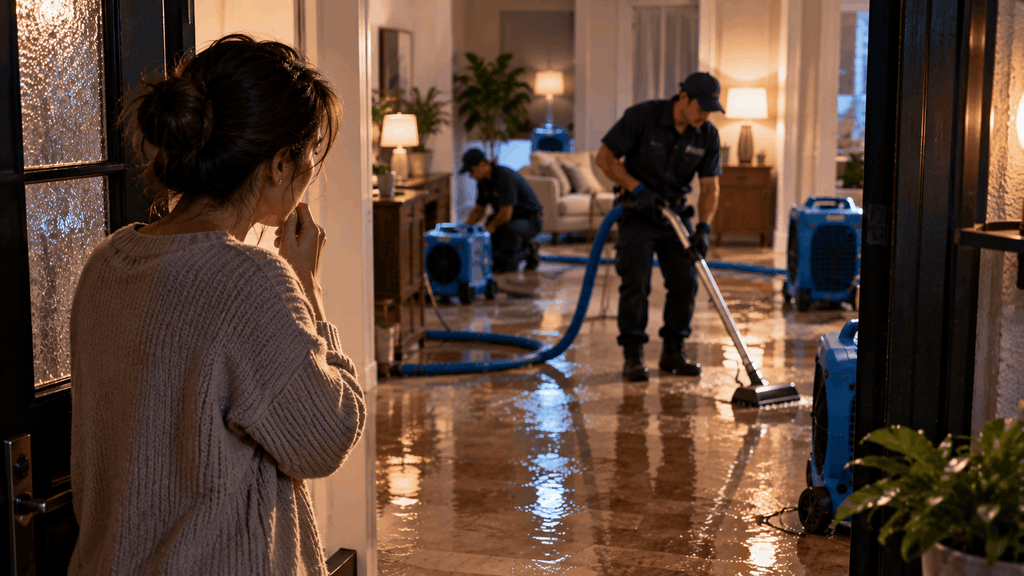
A homeowner standing in two inches of water is not comparing ten companies. She opens two or three websites, decides in seconds who looks legitimate, and calls. Restoration website trust signals are the details that make that decision go your way, and most restoration sites are missing the ones that matter most.
Why Trust Decides Emergency Restoration Leads
Emergency restoration is a strange purchase. The customer is stressed, often at night, frequently dealing with an insurance claim, and about to let strangers into their home. They cannot research for days, so they rely on quick visual and written cues to separate a reliable company from a risky one.
That makes trust the real conversion factor. Two companies with identical rankings can get very different call volumes because one site answers the visitor’s fears in the first screen and the other does not. Traffic you already paid for, through ads or SEO, is wasted if the page fails that quick test.
The questions running through a visitor’s head are predictable. Will someone actually answer the phone right now? How fast can they get here? Are they certified? Will they deal with my insurance company? Are they local, or a call center selling my information? Every strong trust signal answers one of those questions.
Restoration Website Trust Signals Visitors Look For First
A Phone Number and 24/7 Availability Above the Fold
The single most important element is a large, tappable phone number at the top of every page, paired with a clear statement that you answer around the clock. On mobile, a sticky call button that stays on screen as the visitor scrolls removes any hunt for the number.
Availability claims only build trust if they are true. If calls after midnight go to voicemail, the promise backfires and the reviews will say so. Make sure your answering process matches what the website says.
Realistic Response Time Promises
Visitors want to know how soon help will arrive. A specific commitment, such as a crew on site within a stated window for your core service area, is far more reassuring than “fast service.” Only publish a time your team can meet consistently, and define the area it applies to.
Certifications and Credentials
Industry certification is one of the clearest signals of competence. Display IICRC certification and any other relevant credentials, along with state licensing where your market requires it, and proof of insurance. Show the actual badges, name the certifications in text, and link to a page that explains what they mean for the customer, such as trained technicians and industry-standard drying procedures.
Insurance Claim Support
For many customers, the insurance claim is as stressful as the damage. A clear section explaining how you help with claims, whether you document damage with photos and moisture readings, work directly with adjusters, or bill the insurer directly, answers one of the biggest objections. Avoid promising coverage outcomes, since those depend on the policy.
Real Photos of Your Team, Trucks, and Work
Stock photos of smiling models in clean uniforms are easy to spot and do little for credibility. Real photos of your technicians, branded vehicles, equipment on actual job sites, and before-and-after results prove you are a genuine local operation. Name your team members where they are comfortable with it.
Reviews and Ratings in Context
Reviews matter most when they sit next to the decision. Show your Google rating and review count near the top of the page, and feature recent reviews that mention specific services, such as water extraction or mold remediation, and specific details, such as a quick arrival or help with the adjuster. A steady flow of fresh reviews, supported by a structured review management program, keeps this signal strong.
Local Proof That Separates You From Lead Brokers
Many restoration searches are intercepted by lead generation sites that sell the call to whichever contractor pays. Customers increasingly recognize those sites, so looking unmistakably local is a trust signal in itself.
Show a real business address, a local phone number, and a map of your service area. Build service area pages with genuine local content, such as the neighborhoods you cover, common local causes of damage like freeze events or storm flooding, and projects you have completed nearby. Keep your business name, address, and phone number identical across your website, Google Business Profile, and directories, which strengthens both customer trust and your local SEO rankings.
Community ties help too. Membership in the local chamber of commerce, partnerships with local plumbers or property managers, and involvement in community events all tell visitors that you will still be here after the job is done.
Trust Signals Built Into the Page Itself
Some of the strongest restoration website trust signals are not badges at all. They are in how the site works.
Speed is one. A page that takes several seconds to load on a phone signals neglect, and emergency visitors will not wait. Security is another: a site without HTTPS triggers browser warnings that end the visit immediately. Clean, current design matters as well. A dated layout with broken links or a copyright year from years ago raises doubts about whether the business is still active.
Clarity matters most. Every service page should say exactly what you do, what happens after the call, and what the customer should do right now to limit damage. A simple “what to expect” section, covering the call, the arrival, the inspection, the drying process, and the insurance paperwork, lowers anxiety and makes calling feel like the obvious next step. A conversion-focused website design team builds these elements into every template rather than adding them piece by piece.
Service Pages That Build Confidence
Generic service pages that list “water damage, fire damage, mold” in a single paragraph do not build trust. Each major service deserves its own page that shows expertise: water damage restoration, fire and smoke damage, mold remediation, storm damage, and sewage cleanup.
On each page, explain the process in plain language, show relevant certifications, feature reviews from customers who used that specific service, and include before-and-after photos from real jobs. Answer the questions customers ask on the phone, such as how long drying usually takes, whether they can stay in the home, and what the insurance company will need. Pages written this way rank better and convert better, because they prove competence rather than claiming it.
Commercial customers need their own proof. Property managers and facility directors look for commercial project examples, capacity for large losses, and pre-loss planning programs. A dedicated commercial section with those details signals that you can handle more than a single flooded basement.
Trust Signals Beyond Your Website
Visitors rarely judge your website in isolation. They see your Google Business Profile, your ads, and sometimes your social profiles before they ever land on your site. Consistency across all of them is a trust signal on its own.
Your Google Business Profile should show current photos, accurate hours, a complete service list, and prompt responses to reviews. If you run Google Local Services Ads, the verification badge that appears on those ads adds another layer of credibility. And the message on your ads should match the page they lead to: an ad promising a 24/7 emergency response should land on a page that says exactly that.
Restoration website trust signals also affect AI search. When someone asks an AI assistant for a reliable water damage company nearby, those tools lean on consistent business details, reviews, and clear service information. Building your pages with generative engine optimization in mind helps your company show up in those answers as well as in traditional search.
How to Audit Your Own Trust Signals
Open your homepage and your main water damage page on a phone and give yourself five seconds. Can you see the phone number, the 24/7 promise, a rating, and a certification without scrolling? If not, those elements need to move up.
Next, look for anything generic. Stock photos, vague claims, and service pages with no process or proof should be replaced with real images, specific commitments, and customer stories. Check that your name, address, and phone number match everywhere, that your site loads quickly, and that every page has a clear call to action.
Finally, call your own number after hours. Restoration website trust signals only work when the experience behind them matches the promise. The best website in your market cannot save a lead that reaches voicemail.
Restoration Website Trust Signals FAQs
What is the most important trust signal on a restoration website?
A prominent, click-to-call phone number with a clear 24/7 availability statement. Emergency visitors want to reach a person immediately, and anything that slows that down costs calls.
Should restoration companies display IICRC certification?
Yes. IICRC certification is widely recognized in the industry and reassures both homeowners and insurance adjusters. Show the badge, name the certification in text, and explain what it means for the customer.
Do before-and-after photos help conversions?
They do when they come from real jobs. Authentic project photos prove capability and show that you are a genuine local company, while stock images tend to reduce trust.
How should restoration websites handle insurance information?
Explain how you help with the claim process, such as documenting damage and communicating with adjusters, without promising coverage. Customers mainly want to know they will not be left to handle the paperwork alone.
How often should trust signals be updated?
Review counts, photos, and project examples should be refreshed regularly, and every claim should be checked whenever your service area, response times, or certifications change. Outdated details erode credibility quickly.
Earning Trust in the First Five Seconds
In emergency restoration, the company that looks most trustworthy in the first few seconds usually gets the call. Clear availability, real credentials, honest response times, local proof, and a site that loads fast turn stressed visitors into booked jobs. LeadOrigin is an award-winning agency that has generated over $1 billion in revenue for clients, and we build restoration websites designed to convert. Contact our team to find out which trust signals your site is missing.