
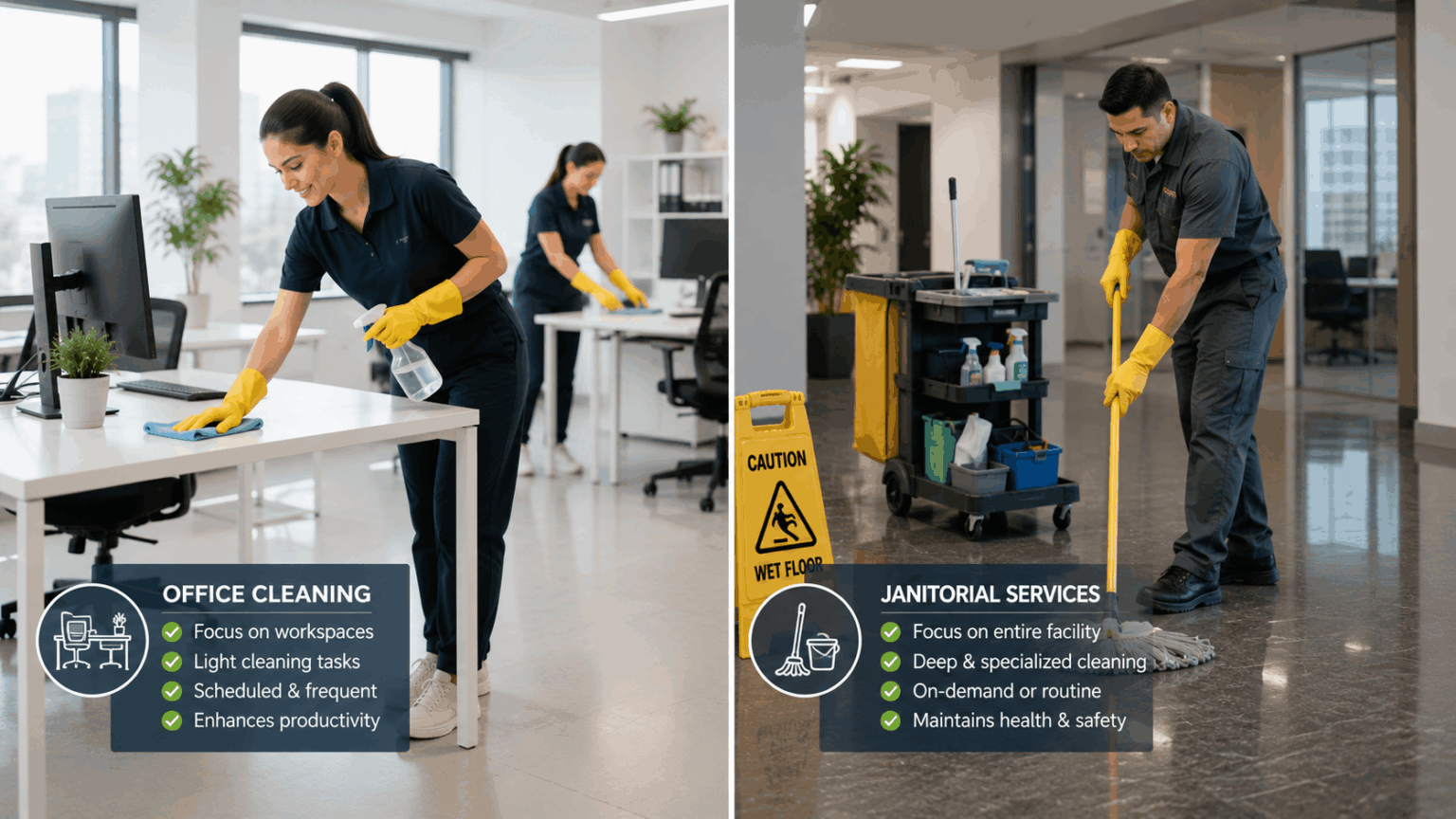
Business owners comparing quotes from facility maintenance providers often run into two terms used almost interchangeably: office cleaning and janitorial services. Understanding office cleaning vs. janitorial services matters because the two overlap in places but are not the same thing, and choosing the wrong category can leave a facility underserved or paying for coverage it does not actually need.
What Office Cleaning Typically Includes
Office cleaning generally refers to a focused set of routine tasks aimed at keeping a workspace presentable and sanitary on a predictable schedule.
Common Daily and Weekly Tasks
A standard office cleaning contract usually covers trash removal, vacuuming, dusting, restroom sanitation, kitchen and breakroom cleaning, and surface disinfection in high-touch areas like doorknobs and light switches. These tasks are typically scheduled a few times a week or nightly, depending on the size and traffic of the space.
Who Typically Uses This Service
Smaller offices, professional service firms, and single-tenant spaces are the most common buyers of straightforward office cleaning. These businesses usually need a clean, professional-looking space without the deeper infrastructure maintenance that larger or more complex facilities require.
What Janitorial Services Typically Include
Janitorial services generally describe a broader, more comprehensive scope of work that goes beyond routine tidying and into ongoing facility upkeep.
A Wider Range of Responsibilities
In addition to the tasks covered under standard office cleaning, janitorial services often include floor care like stripping and waxing, carpet extraction, window washing, supply restocking, and sometimes light maintenance tasks like changing light bulbs or reporting facility issues. The scope is built around keeping an entire building running smoothly, not just keeping surfaces tidy.
On-Site Staffing Models
Larger facilities, such as multi-tenant office buildings, schools, or industrial campuses, often contract janitorial services with staff physically stationed on-site during business hours rather than visiting only after hours. That on-site presence allows for real-time response to spills, restroom needs, or unexpected messes throughout the day.
Key Differences Between the Two
Understanding the practical differences helps a business match the right service to its actual facility needs instead of guessing based on terminology alone.
Frequency and Scope of Work
Office cleaning tends to follow a fixed, recurring checklist focused on appearance and basic sanitation. Janitorial services typically include that same checklist plus a rotating schedule of deeper maintenance tasks, along with the flexibility to respond to issues as they arise during the day rather than only at the next scheduled visit.
Staffing and Scheduling Differences
Office cleaning crews usually work after hours or early morning, visiting multiple client sites in a single day. Janitorial staff are more often assigned to a single facility, sometimes working shifts that overlap with regular business hours, which changes both the cost structure and the level of on-site responsiveness a business can expect.
Contract Structure and Pricing
Office cleaning contracts are typically priced per visit or per square footage based on a fixed scope. Janitorial contracts often involve a more customized pricing structure that accounts for staffing hours, equipment, and the broader range of services included, which usually makes them a larger recurring investment.
Which One Does Your Business Actually Need
The right choice depends less on which term sounds more thorough and more on the practical realities of a specific facility.
When Office Cleaning Is the Right Fit
A single-tenant office under a few thousand square feet with standard business hours and no heavy foot traffic usually does not need on-site staff or the full scope of janitorial services. A scheduled office cleaning arrangement covers the actual need without paying for capacity that would go unused.
When Full Janitorial Services Make More Sense
Multi-tenant buildings, schools, healthcare facilities, and any space with high foot traffic or specialized maintenance needs typically benefit from the broader scope and on-site responsiveness that janitorial services provide. Businesses in these categories evaluating their local visibility often invest in strong local seo to attract tenants or clients, and matching that same standard of thoroughness to facility upkeep protects the impression that marketing investment is designed to create.
Combining Both for Full Facility Coverage
Some facilities benefit from a hybrid arrangement rather than choosing strictly one category over the other.
Layering Office Cleaning Onto a Janitorial Contract
A facility might contract janitorial services for floor care, restocking, and light maintenance while relying on a separate nightly office cleaning visit for daily tidying and trash removal. This layered approach is common in larger buildings where a single provider handles the heavier structural upkeep while a lighter, more frequent service covers daily appearance.
Coordinating Providers to Avoid Gaps
When two different providers cover different aspects of the same facility, a clear written scope for each is essential to avoid tasks falling through the cracks between the two contracts. A short kickoff conversation between both providers, facilitated by the facility manager, usually resolves any ambiguity before it becomes a recurring complaint.
Industry-Specific Considerations Worth Factoring In
Some industries have facility requirements that push the decision more clearly toward one category than the general size-based guidance above would suggest.
Medical and Healthcare Facilities
Medical offices typically require specialized sanitation protocols that go well beyond standard office cleaning, often necessitating a provider experienced in healthcare-grade disinfection regardless of whether the arrangement is technically labeled office cleaning or janitorial services.
Retail and High-Traffic Public Spaces
Retail locations and other public-facing spaces with heavy foot traffic often need the real-time responsiveness of on-site janitorial staff, particularly for restroom upkeep and spill response during business hours, even if the overall square footage would otherwise suggest a smaller-scale arrangement.
Educational and Institutional Buildings
Schools and other institutional buildings usually require both the broader scope of janitorial services and strict compliance with health and safety regulations, making a documented, accountable provider especially important in this category.
Common Misconceptions That Lead to the Wrong Choice
Confusion between these two categories often comes down to a few recurring misconceptions that are worth clearing up directly.
Assuming Janitorial Always Means Better
Some business owners assume a janitorial contract is automatically the more thorough or professional option simply because it sounds more comprehensive. In reality, a small office paying for full janitorial coverage is often paying for on-site staffing and floor care capacity it will rarely use, which is not a better outcome, just a more expensive one.
Assuming Office Cleaning Cannot Scale
On the other side, some facility managers assume a scheduled office cleaning arrangement cannot handle a growing or higher-traffic space. Many providers offer tiered office cleaning packages that add frequency, deep cleaning add-ons, or expanded scope well before a facility needs to move into a full janitorial contract.
Confusing Marketing Language With Actual Scope
Providers do not always use these terms consistently in their own marketing, which means the label on a proposal matters less than the actual scope of work listed in the contract. A business built on clear, accurate messaging in its own search engine optimization and marketing content should expect that same clarity from a facility vendor’s proposal.
Questions to Ask Before Signing Either Contract
A short list of direct questions during the proposal stage prevents most of the confusion and mismatched expectations that come up later.
What Exactly Is Included in the Scope
Ask for a line-by-line breakdown of tasks and frequency rather than relying on the general category label. A provider unwilling or unable to provide that detail in writing is a warning sign regardless of whether the proposal is labeled office cleaning or janitorial services.
How Are Additional Requests Handled
Facility needs change, and a good contract spells out how add-on requests, like an unexpected spill cleanup or a one-time deep clean before a big client visit, get handled and billed. Clarifying this upfront avoids awkward billing surprises later in the relationship.
What Happens If Service Quality Slips
Ask what recourse exists if service quality drops, including notice periods, remediation steps, and contract exit terms. A confident, established provider will have clear answers to this question rather than treating it as an uncomfortable topic to avoid.
How to Choose a Provider for Either Service
Regardless of which category fits a facility’s needs, the same core evaluation criteria apply when selecting a provider.
Documented Processes and Accountability
A reliable provider, whether offering office cleaning or full janitorial services, should be able to produce a written scope of work, a cleaning schedule, and a clear point of contact for reporting issues. That documentation is what separates a dependable long-term partner from an informal arrangement prone to inconsistency.
Insurance, Bonding, and Staff Vetting
Confirm that any provider carries appropriate liability insurance and bonding, and that staff undergo background checks, particularly for on-site janitorial staff who will have regular, unsupervised access to a facility during and after business hours. Businesses building a strong local reputation through their website and marketing should hold their facility vendors to the same standard of professionalism and reliability that they promise their own clients.
Frequently Asked Questions
Is janitorial service more expensive than office cleaning?
Generally, yes. Janitorial services cover a broader scope of work and often include on-site staffing, which typically makes them a larger recurring investment than a scheduled office cleaning visit.
Can a small office use janitorial services instead of office cleaning?
It is possible, but most small offices do not have enough facility complexity to justify the broader scope and on-site staffing that janitorial services provide, making standard office cleaning the more cost-effective fit.
Do janitorial services include floor care and window washing?
Yes, in most cases. Floor stripping and waxing, carpet extraction, and window washing are commonly included in janitorial contracts but are usually offered as add-ons or separate services under a standard office cleaning agreement.
Office Cleaning vs. Janitorial Services: How Do I Know Which I Need?
Consider the size of the facility, foot traffic, hours of operation, and whether real-time response to messes or maintenance issues is necessary. A facility walkthrough with a potential provider is the most reliable way to get a tailored recommendation.
Can I switch from office cleaning to janitorial services later if my needs change?
Yes. Most providers can transition a contract as a business grows or a facility’s needs change, though it typically involves a new scope of work and updated pricing to reflect the expanded service.
Matching the Right Service to Your Facility
Office cleaning and janitorial services solve different problems, and the right choice comes down to the size, complexity, and traffic of a specific facility rather than which term sounds more comprehensive. Weighing office cleaning vs. janitorial services carefully upfront saves a business from paying for capacity it does not need or, worse, leaving real facility gaps unaddressed. Businesses unsure which category fits their situation, or looking to pair strong facility standards with a stronger growth strategy, can reach out to LeadOrigin to talk through what makes sense for their space.