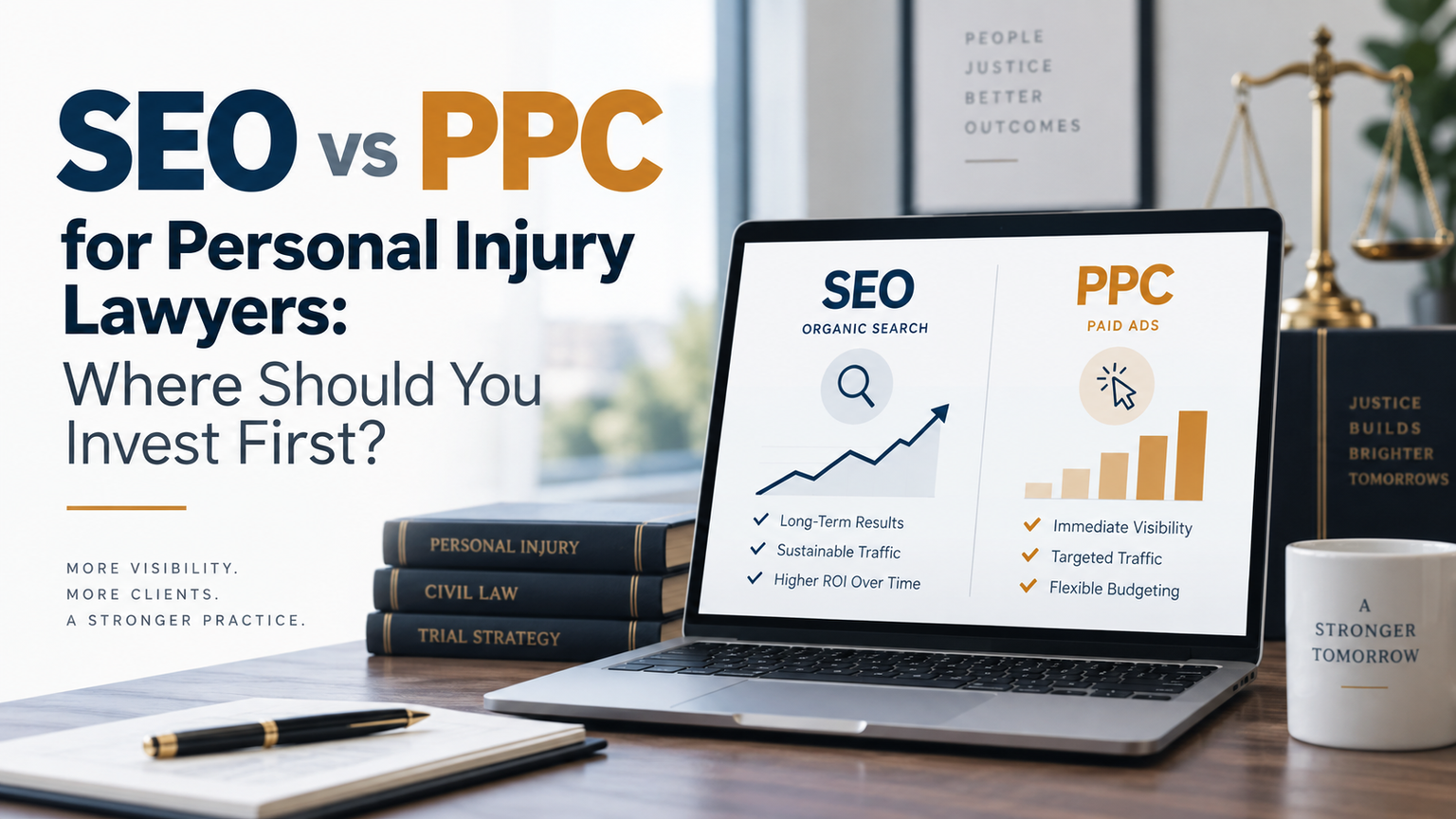
Personal injury lawyers usually have two main ways to get in front of people searching online: SEO and PPC. SEO can build long-term visibility, while PPC can put a law firm in front of potential clients much faster. The right place to invest first depends on how quickly the firm needs leads, how competitive the market is, and what kind of personal injury lawyer lead generation strategy it wants to build.
Here’s how the two compare.
Why Digital Marketing Matters for Personal Injury Lawyers
People looking for a personal injury attorney often start with a search engine. They may search for a lawyer near them, look up a specific type of accident, or compare several firms before deciding who to call.
Personal injury law firm marketing needs to make the firm visible during those searches and give potential clients a reason to take the next step.
How Potential Personal Injury Clients Search for Attorneys
Searches can be broad, such as “personal injury lawyer near me,” or much more specific, such as “car accident lawyer in Dallas” or “truck accident attorney after crash.”
Some people are ready to call immediately. Others may spend time reading service pages, reviews, FAQs, and case information before reaching out.
A strong search strategy needs to reach both types of prospects.
Why Personal Injury Lawyer Lead Generation Is So Competitive
Personal injury cases can be highly valuable, which means many law firms are competing for the same search traffic.
That competition affects both organic rankings and paid advertising costs. Firms need a clear strategy for where to spend, which keywords to target, and how to turn clicks into qualified leads.
What Is SEO for Personal Injury Lawyers?
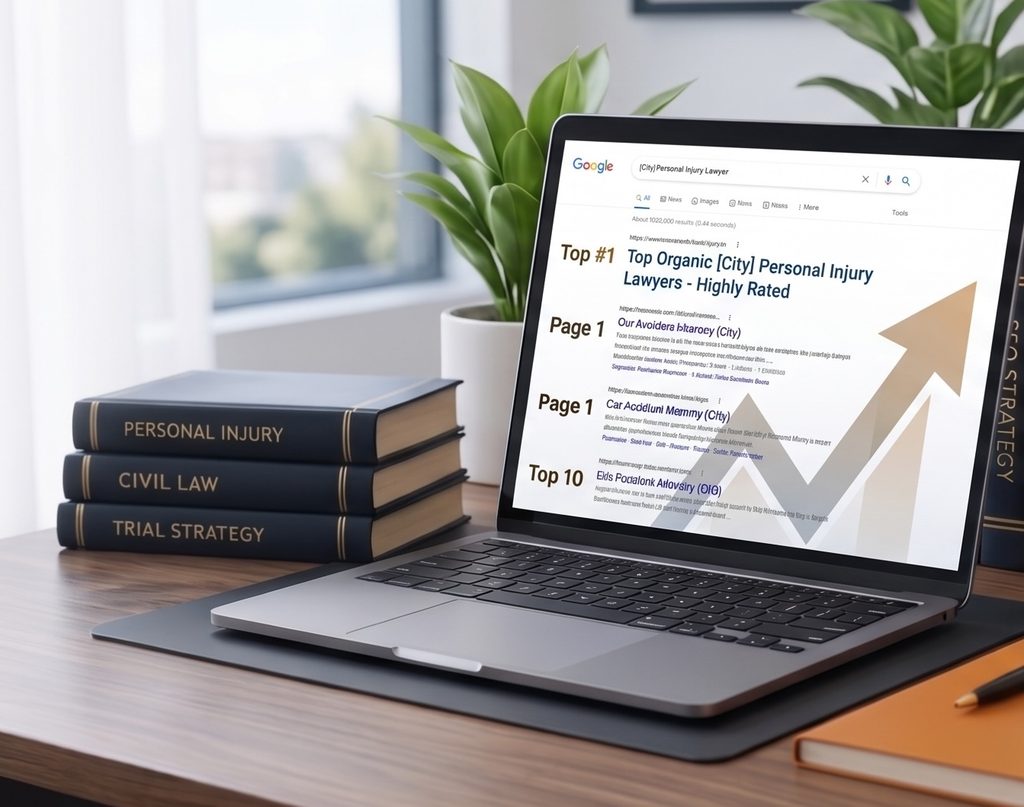
SEO for personal injury lawyers focuses on improving a law firm’s visibility in unpaid search results. The goal is to appear when potential clients search for relevant legal services, questions, and local attorneys.
How Personal Injury Lawyer SEO Works
Personal injury lawyer SEO usually involves several areas working together, including:
- Keyword research
- Service page optimization
- Local SEO
- Google Business Profile optimization
- Content creation
- Technical SEO
- Link building
- Website speed and usability
- Conversion optimization
The idea is to build a website that search engines can understand and potential clients find useful.
Benefits of SEO for Personal Injury Lawyers
One of the biggest advantages of SEO is that it can create long-term visibility. A well-ranking page can continue attracting potential clients without paying for every individual click.
SEO also gives firms opportunities to rank for many different searches, including service keywords, local searches, informational questions, and long-tail terms.
Over time, this can support a broader personal injury attorney marketing strategy.
Limitations of Personal Injury Lawyer SEO
SEO usually takes time. Competitive personal injury keywords can be difficult to rank for, especially in major cities where established firms already have strong websites and authority.
Results are also not guaranteed. Rankings can change, competitors can improve their SEO, and search engine updates can affect visibility.
For firms that need leads quickly, that wait can be a problem. PPC solves a different part of the challenge.
What Is PPC for Personal Injury Lawyers?
PPC, or pay-per-click advertising, allows law firms to pay for placement in search results and other advertising platforms. The firm pays when someone interacts with the ad, depending on the campaign setup.
For personal injury lawyers, paid search is often used to reach people already looking for legal help.
How Google Ads for Personal Injury Lawyers Work
Google Ads for personal injury lawyers can target searches such as:
- Personal injury lawyer near me
- Car accident attorney
- Slip and fall lawyer
- Truck accident lawyer
- Motorcycle accident attorney
Advertisers bid for visibility on relevant searches. Ad placement can depend on factors such as bid amount, competition, relevance, landing page quality, and campaign settings.
Once the ad is live, the firm can start generating traffic almost immediately.
Benefits of PPC for Personal Injury Lawyers
Personal injury lawyer PPC gives firms much more control over when and where they appear.
Campaigns can target specific:
- Keywords
- Locations
- Practice areas
- Devices
- Schedules
- Audiences
This makes PPC useful when a firm wants to generate leads quickly, test a new market, or promote a specific practice area.
It also provides fast data. Firms can see which keywords, ads, and landing pages are producing calls and form submissions.
Limitations of PPC for Personal Injury Lawyers
The biggest drawback is cost. Personal injury keywords are often highly competitive, and poor campaign management can burn through a budget quickly.
Traffic also stops when the ads stop running.
PPC therefore works best when firms closely track lead quality, signed cases, and cost per acquisition rather than focusing only on clicks.
With the basics of both channels clear, the next question is how they actually compare.
Read more: Common Ad Mistakes Personal Injury Firms Should Avoid
SEO vs PPC for Personal Injury Lawyers: Key Differences
SEO and PPC can both generate leads, but they work on different timelines.
SEO focuses on building organic visibility that can grow over time. PPC focuses on buying immediate visibility for selected searches.
The main differences come down to speed, cost structure, control, and long-term value.
SEO vs PPC Comparison for Personal Injury Law Firm Marketing
| Factor | SEO | PPC |
| Speed | Usually takes time to build | Can generate traffic quickly |
| Cost model | Ongoing investment in strategy and content | Pay for advertising traffic |
| Visibility | Organic search results | Paid search placements |
| Long-term value | Can continue producing traffic over time | Traffic usually stops when spending stops |
| Targeting | Based on keywords, content, and local relevance | Highly controlled by keyword, location, audience, and schedule |
| Testing | Slower to gather meaningful results | Faster testing of keywords and offers |
| Competition | Difficult in crowded markets | Can become expensive in crowded markets |
| Best use | Building long-term search visibility | Generating faster demand and testing campaigns |
Neither one is automatically better. The stronger choice depends on what the firm needs right now.
When Should Personal Injury Lawyers Invest in SEO First?
SEO may be the better first investment when the firm wants to build a long-term source of organic traffic and has time to let that strategy grow.
It can also make sense for firms that already generate some business through referrals or other channels and want to strengthen their online presence gradually.
Signs Your Personal Injury Law Firm Needs SEO
SEO may deserve priority if:
- The website ranks poorly for core practice areas
- Local competitors consistently outrank the firm
- Service pages are thin or outdated
- The firm has little useful content
- Local search visibility is weak
- The website receives very little organic traffic
- The firm wants to rely less heavily on paid traffic over time
SEO gives the firm a stronger foundation, but there are situations where waiting months for organic growth is not practical.
Read more: Local SEO Opportunities for Personal Injury Attorneys
When Should Personal Injury Lawyers Invest in PPC First?
PPC can make more sense when the firm needs visibility quickly.
A new firm, a new office, or a firm launching a new practice area may not have enough organic authority to rank right away. Paid search can help put the firm in front of potential clients while SEO is still gaining traction.
Signs Your Personal Injury Law Firm Could Benefit From PPC
PPC may be a strong first move if:
- The firm needs leads quickly
- Organic rankings are still weak
- A new market or office is launching
- The firm wants to test specific practice areas
- There is budget available for paid acquisition
- The intake team can handle additional lead volume
- Conversion tracking is already in place
PPC can create faster activity, but it should not automatically replace SEO. In many cases, the better strategy is to use both.
Read more: Paid Ads Strategies for Personal Injury Lawyers
Should Personal Injury Lawyers Use SEO and PPC Together?
Yes. SEO and PPC can support each other when they are managed as part of the same personal injury law firm marketing strategy.
One channel can provide immediate visibility while the other builds long-term growth.
Use PPC While SEO Rankings Are Growing
SEO may take time to gain traction. PPC can help fill that gap by generating search visibility while new service pages, local pages, and content begin climbing the rankings.
This can be especially useful for newer firms.
Use PPC Data to Improve Personal Injury Lawyer SEO
Paid campaigns can quickly show which keywords generate strong leads.
That data can help guide SEO decisions, such as which service pages to improve, which locations to target, and which search terms deserve more content.
Use SEO to Reduce Long-Term Dependence on PPC
As organic rankings grow, firms may start generating more leads without paying for every click.
This can make the overall acquisition strategy more balanced and give the firm another source of traffic if advertising costs rise.
Dominate More Search Engine Results
Using both channels can also give a firm more visibility on the same search results page.
A firm may appear in paid results, local listings, and organic search at the same time, increasing the number of opportunities a prospect has to see the brand.
The ideal mix depends largely on budget and stage of growth.
How to Divide Your Personal Injury Law Firm Marketing Budget
There is no universal percentage that works for every firm. Budget decisions should depend on current rankings, market competition, lead goals, cash flow, and how quickly the firm needs results.
The strategy may also change as the firm grows.
Strategy for a New Personal Injury Law Firm
A newer firm may need PPC to start generating opportunities while SEO is being built.
Part of the budget can go toward paid campaigns for immediate visibility, while another portion supports website improvements, local SEO, content, and technical work that can create long-term value.
Strategy for an Established Personal Injury Law Firm
An established firm with strong organic rankings may already receive steady SEO traffic.
PPC can then be used more selectively for competitive keywords, priority practice areas, branded protection, or markets where organic visibility is weaker.
Strategy for Firms Entering a New Market
A firm expanding into another city may have little organic visibility there at first.
PPC can create immediate exposure while local SEO, service-area pages, reviews, links, and other organic signals are developed.
No matter how the budget is split, the decision should come back to return on investment.
How Personal Injury Lawyers Can Measure SEO and PPC ROI
Clicks and traffic are useful, but signed cases matter more.
For both SEO and PPC, firms should track:
- Leads generated
- Qualified leads
- Phone calls
- Form submissions
- Consultations booked
- Consultation show rate
- Signed cases
- Cost per lead
- Cost per qualified lead
- Cost per signed case
- Revenue or case value by source
SEO reporting should also include organic rankings and traffic, while PPC reporting should include ad spend, click-through rate, cost per click, and campaign-level conversion data.
Connecting marketing sources with the intake process gives personal injury lawyers a much clearer picture of what is actually working.
Common SEO and PPC Mistakes Personal Injury Lawyers Should Avoid
Both channels can waste money when the strategy stops at generating traffic.
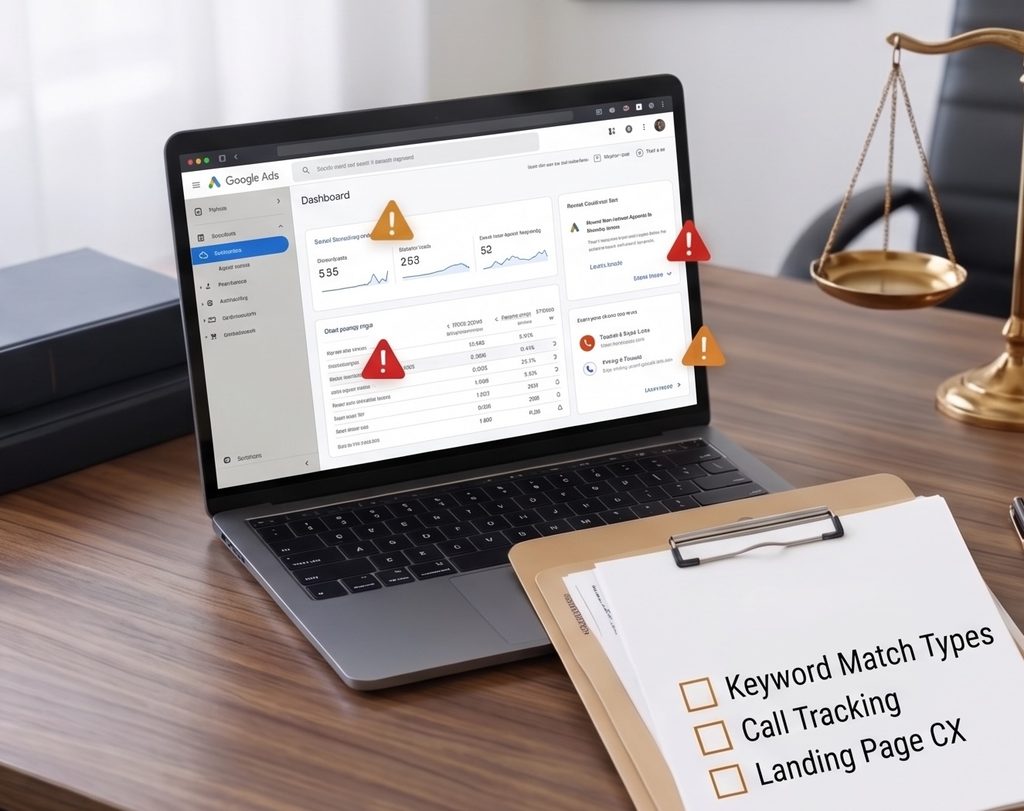
Common mistakes include:
- Targeting broad keywords without considering intent
- Sending paid traffic to weak landing pages
- Ignoring local SEO
- Creating thin service or location pages
- Measuring clicks instead of qualified leads
- Failing to track phone calls
- Using the same strategy for every practice area
- Increasing ad spend when intake cannot handle more leads
- Ignoring leads that come in after hours
- Failing to connect marketing sources with signed cases
Marketing performance depends on what happens after the click as much as what happens before it.
SEO or PPC: Which Is Better for Personal Injury Lawyers?
For most personal injury lawyers, the strongest long-term answer is not choosing one forever. It is deciding which channel deserves priority now and how the other can support it.
SEO makes sense for firms focused on building durable organic visibility. PPC makes sense when the firm needs faster lead generation, more control, or immediate exposure in a competitive market.
A well-rounded personal injury lawyer lead generation strategy can use PPC for speed and testing while SEO builds a stronger organic presence over time.
LeadOrigin helps personal injury firms figure out where SEO and PPC can have the greatest impact. Ready to use your marketing budget better? Contact LeadOrigin to review your current strategy and find the right mix for generating more qualified leads.
Frequently Asked Questions
Is SEO worth it for personal injury lawyers?
Yes. SEO can help personal injury lawyers build long-term visibility for high-intent searches, local keywords, service pages, and informational queries. It can take time to produce results, especially in competitive markets, but strong rankings can become a valuable ongoing source of leads.
How long does SEO take for personal injury lawyers?
There is no fixed timeline. Results depend on the firm’s current website, market competition, domain authority, location, content quality, technical SEO, and backlink profile. Competitive personal injury markets generally require a longer-term SEO strategy rather than expecting immediate ranking changes.
How much does PPC cost for personal injury lawyers?
PPC costs vary widely based on location, keyword competition, practice area, targeting, and campaign quality. Personal injury keywords can be highly competitive, so firms should focus on cost per qualified lead and cost per signed case rather than looking at cost per click alone.
Is SEO or Google Ads better for personal injury lawyers?
SEO is usually stronger for long-term organic visibility, while Google Ads can generate exposure and leads much faster. Many personal injury firms benefit from using both, with PPC supporting immediate demand while SEO builds over time.
Should a new personal injury law firm start with SEO or PPC?
A new personal injury law firm may benefit from starting both at the same time. PPC can create visibility while the firm has little organic presence, while SEO builds the website, local rankings, content, and authority needed for longer-term lead generation.