
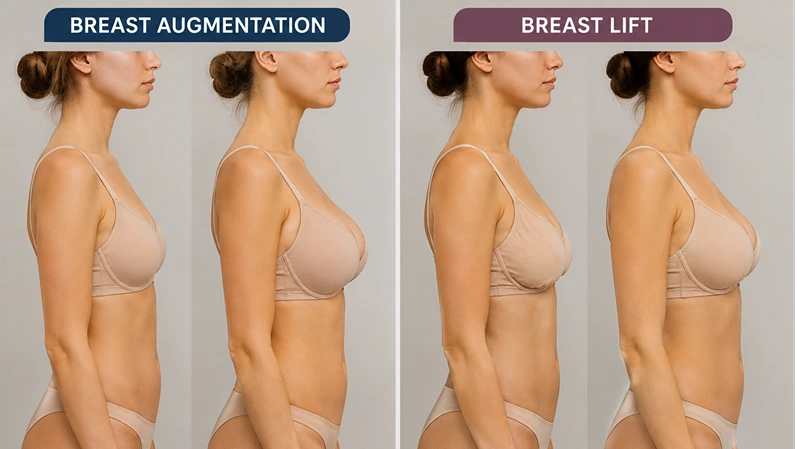
Patients researching breast surgery often assume augmentation and a lift solve the same problem, just with different names. In reality, breast augmentation vs. breast lift addresses two distinct concerns, and understanding that difference upfront leads to a far more productive consultation and a result that actually matches what the patient wants.
What Each Procedure Actually Addresses
The confusion between these two procedures usually comes down to a simple misunderstanding: one changes size, the other changes position.
Breast Augmentation Adds Volume
Augmentation uses implants, or in some cases fat transfer, to increase breast size and fullness. It is the right solution for patients who feel their breasts are too small relative to their frame, or who want to restore volume lost after pregnancy or weight change, without addressing where the breast tissue currently sits on the chest wall.
Breast Lift Repositions Existing Tissue
A lift, known clinically as mastopexy, removes excess skin and reshapes the breast tissue to raise it to a more youthful position. It does not add volume. Patients whose breasts have sagged due to aging, pregnancy, or significant weight loss, but who are otherwise happy with their size, are typically better candidates for a lift alone.
Why Patients Often Need Both
Many patients considering breast augmentation vs. breast lift discover during a consultation that their goals actually require a combination of the two procedures rather than either one in isolation.
Volume Loss Combined With Sagging
Pregnancy and breastfeeding frequently cause both volume loss and drooping at the same time. In these cases, an implant alone would sit inside sagging tissue without correcting its position, while a lift alone would leave the breast smaller than the patient wants. Combining augmentation with mastopexy addresses both issues in a single surgery.
Evaluating Candidacy During Consultation
A qualified surgeon evaluates skin elasticity, nipple position relative to the breast fold, and existing volume before recommending one approach over the other. Practices that make this evaluation process clear before a patient ever steps into the office tend to see fewer consultation no-shows and more patients arriving already informed about what to expect.
Recovery Differences Between the Two Procedures
Recovery timelines and considerations vary meaningfully depending on which procedure, or combination, a patient undergoes.
Augmentation Recovery Basics
Augmentation alone typically involves a shorter initial recovery, with most patients returning to non-strenuous work within a week, though full settling of the implants can take several months. Swelling and tightness across the chest are common in the first few weeks.
Lift Recovery Involves More Incision Care
Because mastopexy involves more extensive incisions to remove excess skin, recovery generally requires more attention to incision care and a longer period of activity restriction. Combined procedures naturally extend recovery timelines compared to either surgery performed alone.
Cost Considerations for Each Option
Pricing varies by geographic market, surgeon experience, and whether the procedures are combined, but understanding the general cost structure helps patients budget realistically before a consultation.
Augmentation Pricing Factors
Implant type, whether saline or silicone, along with surgeon fees and facility costs, are the primary drivers of augmentation pricing. Patients researching options can review a detailed breakdown of breast augmentation costs to understand what typically factors into a quote.
Lift and Combined Procedure Pricing
A standalone lift is often priced separately from an implant, and combining the two procedures usually costs less than scheduling them as two separate surgeries because facility and anesthesia fees are shared. Patients can also review typical mastopexy pricing to compare against augmentation-only quotes.
How Practices Help Patients Choose the Right Path

Clear, accurate information before a consultation reduces confusion and helps patients arrive with realistic expectations about which procedure actually fits their goals.
Educational Content Builds Confidence Before the Visit
Practices that publish detailed, accurate explanations of the difference between these procedures see patients arrive at consultations already narrowing down what they want, which shortens the sales cycle and improves satisfaction. Investing in plastic surgery marketing that prioritizes genuine patient education over vague before-and-after photos tends to attract higher-quality consultation requests.
Building Trust Before the First Appointment
Patients researching a sensitive, high-cost procedure want to feel confident in a surgeon before they ever pick up the phone. Practices that focus on building patient trust before the consultation through transparent content and clear procedure explanations consistently convert more of that early research interest into booked appointments.
Implant Type Matters More Than Most Patients Expect
For patients leaning toward augmentation, or a combined procedure, the choice between implant types shapes both the look and feel of the final result.
Saline Versus Silicone
Saline implants are filled after placement, allowing for a smaller incision, and any leak is immediately noticeable and safely absorbed by the body. Silicone implants are pre-filled and tend to feel closer to natural breast tissue, though a leak is harder to detect without imaging. Neither option is universally better; the right choice depends on the patient’s anatomy, incision preferences, and desired feel.
Safety Considerations Worth Discussing Upfront
Any surgical procedure carries risk, and augmentation is no exception. Patients considering the procedure benefit from reviewing detailed safety information, such as this overview of breast augmentation safety, before their consultation so they arrive with informed questions rather than generic worries.
Setting Realistic Expectations During Consultation
A thorough consultation is where theoretical differences between augmentation and a lift become concrete, personalized recommendations.
Physical Evaluation Drives the Recommendation
Surgeons assess skin elasticity, breast tissue density, and the position of the nipple relative to the inframammary fold to determine candidacy for each option. This physical evaluation, not a patient’s initial preference alone, ultimately determines whether augmentation, a lift, or a combination produces the best outcome.
Discussing Long-Term Maintenance
Implants are not lifetime devices, and most patients will need a revision or replacement at some point, typically within ten to twenty years depending on the implant type and how the body responds over time. A lift alone does not carry this same maintenance consideration, since there is no device to monitor, though the effects of gravity and aging will still apply over time.
The Emotional Side of Choosing a Procedure
Beyond the physical mechanics, patients weighing these options often carry emotional expectations that deserve just as much attention during a consultation.
Body Image and Motivation
Patients pursuing augmentation are often motivated by a desire for proportion or fullness they feel they never had, while patients seeking a lift are frequently trying to reclaim how their body looked before pregnancy, weight loss, or aging changed its shape. Understanding this underlying motivation helps a surgeon recommend the option that actually addresses what the patient is hoping to feel, not just how they want to look in a mirror.
Managing Expectations Around Scarring
A lift involves more extensive incisions than augmentation alone, and patients need realistic expectations about resulting scars, which fade considerably over the first year but do not disappear entirely. Augmentation performed through a smaller incision leaves less visible scarring but does not address any existing sagging, which is an important tradeoff to discuss honestly during a consultation.
Why Practice Reputation Shapes Patient Confidence
Beyond the technical differences between procedures, patients researching this decision are also evaluating who they trust to perform it.
Board Certification and Training Matter
Patients researching either procedure should confirm a surgeon’s board certification and specific training in breast surgery, since outcomes vary significantly based on surgeon experience with the specific technique being considered. This is often the single most important factor patients overlook while focused on comparing procedures rather than comparing surgeons.
How Practices Communicate This Expertise Online
A practice’s website and content play a direct role in communicating this expertise before a patient ever sits down for a consultation. Practices that focus on generating qualified plastic surgeon consultation requests through genuine credential-focused content, rather than generic stock photography, tend to attract patients who arrive already confident in the surgeon’s qualifications.
Timing the Decision Around Life Changes

Many patients wonder whether to wait before scheduling either procedure, particularly if future pregnancies or major weight changes are a possibility.
Why Surgeons Often Recommend Waiting
Pregnancy and significant weight fluctuations after augmentation or a lift can undo much of the result, stretching skin and tissue in ways that may require a revision procedure. Surgeons typically recommend patients complete their family planning, or reach a stable weight, before scheduling either surgery to get the most durable outcome.
Planning Around Recovery Time
Recovery for either procedure, and especially for a combined surgery, requires several weeks of reduced activity and lifting restrictions. Patients planning around work schedules, childcare, or upcoming events should build in a buffer beyond the minimum recovery window their surgeon provides, since individual healing timelines vary.
Frequently Asked Questions
Can breast augmentation and a breast lift be done at the same time?
Yes. Combining augmentation with mastopexy is common for patients dealing with both volume loss and sagging, and it is often more cost-effective than scheduling the procedures separately.
How do I know if I need a lift, augmentation, or both?
A consultation with a board-certified plastic surgeon, including an evaluation of skin elasticity and nipple position, is the most reliable way to determine which approach fits your specific anatomy and goals.
Does a breast lift include implants?
No. A standard breast lift repositions existing tissue and removes excess skin but does not add volume. Implants are only included if augmentation is performed alongside the lift.
Which procedure has a longer recovery, augmentation or a lift?
A standalone lift generally requires more attention to incision care and a somewhat longer recovery than augmentation alone, due to the more extensive incisions involved in repositioning tissue.
Will results from either procedure look natural?
Results depend heavily on surgeon skill, implant selection, and individual anatomy. A thorough consultation that reviews your goals and physical characteristics is the best way to set realistic, natural-looking expectations.
Choosing Between Augmentation and a Lift With Confidence
To understand the real difference between breast augmentation and a breast lift: one adds volume; the other repositions tissue, giving patients a much stronger foundation for their consultation and eventual decision. Practices looking to attract patients who arrive already informed and ready to book can explore how LeadOrigin approaches plastic surgery marketing to see what a stronger content and visibility strategy can look like.