In an era where contractor marketing conversations center on SEO rankings, LinkedIn presence, and portfolio websites, the capability statement is sometimes dismissed as a relic of pre-digital procurement. It is not. For commercial construction companies pursuing government contracts, institutional projects, and developer relationships, the capability statement remains one of the most actively requested and closely evaluated documents in the procurement process. The question is not whether to have one; it is whether yours is doing the work it needs to do.
What a Capability Statement Is and Why It Still Gets Used
The Document That Opens Procurement Doors
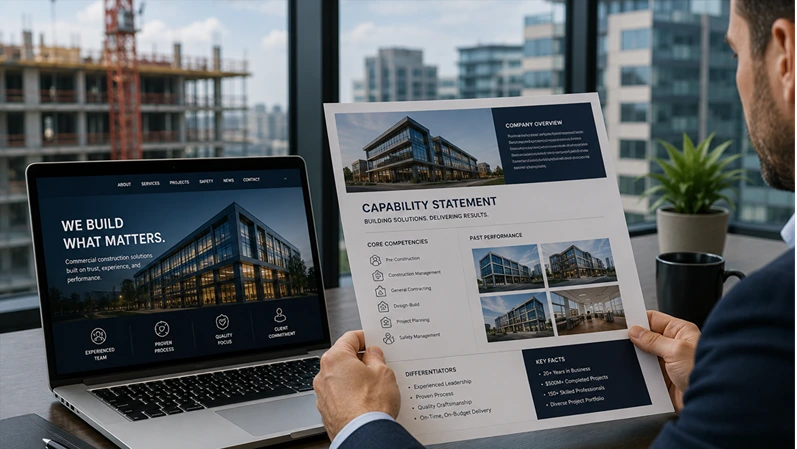
A capability statement is a structured, concise document, typically one to two pages, that summarizes a contractor’s qualifications, experience, differentiators, and contact information in a format designed for fast evaluation by procurement officers, developers, and owner’s representatives. It is used in response to RFI submissions, government set-aside pre-qualification processes, developer networking events, and direct outreach to prospective clients.
Unlike a full proposal or a project portfolio, the capability statement is designed to be reviewed in under two minutes and make a clear, positive impression in that window. It functions as a leave-behind, a pre-qualification tool, and in some government procurement contexts, a required submission format. A contractor without a professional capability statement is excluded from processes where one is required, and poorly positioned in processes where competitors who have one show up better prepared.
Why Digital Marketing Has Not Replaced It
The rise of digital marketing has expanded the channels through which contractors build credibility, but it has not eliminated the contexts in which a capability statement is the expected and appropriate format. Government procurement processes, particularly those involving small business certifications, set-asides, or federal pre-qualification, routinely require capability statement submissions in a specific format.
Developers who meet contractors at industry events, receive introductions through professional networks, or engage in early-stage conversations about upcoming projects often ask for a capability statement as the natural next step. In these contexts, a contractor who responds with a website link rather than a polished document signals a lack of preparation that undermines the impression created in the meeting.
Content writing for commercial contractors should treat the capability statement as a core marketing asset produced and maintained with the same rigor as the company website, not as an afterthought assembled from old proposal language.
What a Strong Capability Statement Includes

Core Elements That Every Statement Needs
A professional capability statement for a commercial construction company includes several non-negotiable elements: a company overview that communicates scale and type of work, a core competencies section that names specific capabilities and sectors served, a differentiators section that articulates what makes the company the better choice, a past performance section that documents relevant completed projects with client names and outcomes where possible, and company data including certifications, bonding capacity, licensing, and contact information.
Each section must be written for speed of comprehension. A procurement officer reviewing 40 capability statements in a day is not reading carefully; they are scanning for the signals that confirm a contractor meets their criteria. Every section must surface those signals immediately, without requiring the reader to work for the relevant information.
The Differentiators Section Is Where Most Contractors Fail
The most common weakness in contractor capability statements is a vague or generic differentiators section. Phrases like “commitment to quality,” “on-time delivery,” and “client-focused approach” are used by nearly every contractor and communicate nothing specific. A differentiator is only useful if it is specific, verifiable, and meaningfully different from what competitors claim.
Effective differentiators for commercial contractors are concrete: “98% client retention rate across 12 years of operations,” “in-house BIM coordination team that has eliminated design conflicts on every project in the past four years,” or “design-build delivery experience across 22 healthcare facilities in Texas.” These claims are specific, they imply verifiability, and they give a procurement officer or developer a clear reason to continue the conversation.
Reputation management that systematically collects client feedback and documents project performance data gives contractors the raw material needed to populate a differentiators section with specific, credible claims rather than generic marketing language.
Past Performance That Demonstrates Relevant Experience
The past performance section of a capability statement should be curated to match the audience receiving it. A capability statement submitted for healthcare construction pre-qualification should prominently feature healthcare projects. One submitted for a government set-aside program should lead with projects of the appropriate size and contract type. Using a single generic capability statement across contexts is a missed opportunity to demonstrate relevance.
Maintaining a master library of documented project entries, each with the client name, project type, approximate value, scope summary, and outcome, allows a contractor to rapidly customize the past performance section for different audiences without having to start from scratch each time. This library also serves as the foundation for the project portfolio on the company website, creating consistency between digital and document-based marketing assets.
Connecting Capability Statements to Your Digital Strategy
The Website and the Capability Statement Should Reinforce Each Other
A developer or procurement officer who receives a capability statement will frequently visit the contractor’s website before making a follow-up decision. If the website and the capability statement present inconsistent information, different project lists, different company descriptions, or different contact details, the inconsistency raises credibility questions that undermine both documents.
Website design for commercial contractors should be developed with the capability statement in mind, ensuring that the core claims, project evidence, and company positioning presented in both documents are consistent and mutually reinforcing. A prospect moving from the capability statement to the website should find deeper evidence of everything the statement asserts, not a different story.
Make the Capability Statement Downloadable on Your Website
Contractors who make a polished capability statement available as a downloadable PDF on their website give prospects the ability to save and share it without requiring a direct request. Developers who are beginning to build a shortlist, government procurement officers who are pre-qualifying vendors, and project managers who want to recommend a contractor to an internal decision-maker all benefit from being able to access and share a capability statement on demand.
Onsite SEO can support this by creating a dedicated page for contractor qualifications or pre-qualification that includes the downloadable capability statement alongside relevant certifications, bonding documentation, and safety record information. This page becomes a single destination for every due diligence question a prospect might have.
Using LinkedIn to Amplify Capability Statement Content
Key elements of the capability statement, particularly differentiators and notable past performance entries, can be repurposed as LinkedIn content to reach developer and institutional buyer audiences organically. A post describing a specific project outcome, framed as an insight about what made the project successful, demonstrates capability without feeling like an advertisement.
Social media management for commercial contractors should create a content calendar that systematically surfaces capability statement content in formats appropriate for each social platform, extending the contractor’s core marketing message beyond the contexts in which the document itself is distributed.
Keeping the Capability Statement Current
Update Cadence and Version Control
A capability statement that reflects projects completed three years ago and certifications that have since lapsed is actively damaging rather than neutral. Procurement officers who notice outdated information question whether the contractor’s operations are as organized as their marketing suggests. Establish a quarterly review cadence to update past performance entries, verify that all certifications and registration numbers are current, and refresh any performance metrics cited in the differentiators section.
Version control matters when multiple people on the business development team are distributing the document. A centralized, clearly dated master version prevents outdated copies from circulating without the company’s knowledge.
Paid search ads and paid social ads campaigns that drive traffic to a contractor’s pre-qualification or qualifications page amplify the reach of the capability statement content to developers and procurement professionals who are actively searching for qualified contractors in relevant sectors and geographies.
Frequently Asked Questions About Capability Statements in Digital Contractor Marketing
How long should a commercial contractor’s capability statement be?
One to two pages is the standard for most procurement contexts. Government pre-qualification formats sometimes specify a single page, particularly for SAM.gov registrations and federal set-aside programs. For private sector developer outreach, two pages allow enough space to present core competencies, past performance, and differentiators without requiring the reader to manage a lengthy document. Anything beyond two pages should be reserved for formal proposals.
Should capability statements be customized for each submission?
The core structure should remain consistent, but the past performance section should be curated to reflect the most relevant projects for each specific opportunity. If a contractor is submitting for a medical office development pre-qualification, leading with healthcare projects makes a stronger impression than a generic project list. Maintaining a master project library makes customization fast without requiring a full document rebuild.
How is a capability statement different from a company brochure?
A company brochure is typically designed for broad awareness and brand impression, often emphasizing visual identity and general positioning. A capability statement is a procurement document designed for functional evaluation: Does this contractor meet our criteria? The capability statement should be more information-dense, more specific about past performance, and more clearly structured around the reader’s evaluation criteria rather than the contractor’s marketing preferences.
Do subcontractors need capability statements?
Yes, particularly subcontractors pursuing pre-qualification with general contractors, government agencies, or developers who require documentation of subcontractor qualifications. A subcontractor capability statement typically emphasizes trade-specific certifications, bonding capacity for their scope, relevant past performance on similar projects, and safety record. The same principles of specificity and credibility apply.
Where should a contractor distribute capability statements beyond direct submission?
Beyond direct procurement submissions, capability statements should be available on the company website as a downloadable PDF, distributed at industry networking events, included in introductory email outreach to prospective developer clients, and provided to architects and engineers who may recommend contractors for projects in the design phase. Each distribution context is an opportunity to make a strong first impression with a prospect who may not yet have encountered the company’s digital presence.
Make Your Capability Statement the Document That Wins the First Meeting
A capability statement that is specific, up to date, and structured around the buyer’s evaluation criteria consistently outperforms generic documents in procurement processes and developer conversations. The contractors that invest in building and maintaining a professional capability statement win more first meetings, more pre-qualifications, and more spots on developer shortlists. LeadOrigin helps construction and B2B service companies build the full-spectrum marketing systems that support every stage of the client acquisition process, from digital visibility to document quality. Contact our team to build a marketing system that works as hard as your crew does.