

Two brokerages pitch the same owner for the same listing. Both have comparable experience, similar fee structures, and a stack of past deals. The one that wins is usually the one the owner already recognized, trusted, and remembered before the meeting started. That is what strong commercial real estate branding does: it earns preference long before a proposal is sent.
Commercial real estate is a business-to-business industry, but people still make the decisions. Asset managers, tenant reps, investors, and corporate real estate directors all respond to clarity, credibility, and consistency. This guide breaks down the branding strategies that help firms and properties stand out in crowded markets.
Why Branding Matters in a Relationship-Driven Industry
For years, many CRE firms treated branding as a logo, a business card, and a building sign. Deals came through relationships, so marketing felt optional. That model is weaker today. Owners research brokerages online before shortlisting them. Tenants compare buildings on their phones before touring. Investors look for a sponsor’s track record, market point of view, and online presence before they ever request an offering memorandum.
A clear brand shortens that evaluation. It tells the market what you specialize in, why you are credible, and what working with you feels like. When those answers are obvious, your team spends less time explaining itself and more time closing.

Where Commercial Real Estate Branding Applies
Branding in this industry works on several levels at once, and the strongest firms manage each one deliberately. Effective commercial real estate branding connects all four levels so that a prospect who meets your firm through a property sign, a LinkedIn post, or a leasing flyer gets the same impression every time. When one level is neglected, such as a polished firm website paired with dated property signage, the gap weakens trust in everything else.
The Firm Brand
This is the brokerage, developer, property management company, or investment firm itself. It covers your name, identity, positioning, website, and reputation. The firm brand is what owners and investors evaluate when choosing a partner.
The Asset Brand
Individual properties can carry their own brand, especially mixed-use developments, office towers, industrial parks, and lifestyle retail centers. A property name, logo, signage system, and website create recognition that helps leasing and supports long-term value.
The Experience Brand
Lobbies, amenity spaces, wayfinding, and tenant communications all shape how a property feels day to day. This level matters most for retention, since tenants who enjoy the building are more likely to renew and refer.
The Campaign Brand
Leasing and disposition campaigns need their own look and message, built within the firm or asset brand. A lease-up campaign for a new industrial building speaks differently than a sale campaign aimed at institutional buyers.
Treating these levels as one connected system is what separates a strategic CRE brand from a collection of mismatched flyers.
Define Your Positioning Before Your Visuals
The most common branding mistake is starting with a logo. Visual identity should express a strategy, not replace one.
Choose What You Want to Be Known For
Firms that try to be everything to everyone rarely stand out. Pick a lane you can credibly own, such as an asset class, a submarket, a client type, or a deal type. “Industrial tenant representation in the Houston-Galveston corridor” is far more memorable than “full-service commercial real estate.” You can still take other work. The point is to lead with your sharpest strength.
Write a Positioning Statement
A good positioning statement answers four questions in one or two sentences: who you serve, what you do for them, how you do it differently, and why they should believe you. This statement becomes the filter for your website copy, pitch decks, LinkedIn profiles, and listing materials.
Audit Your Competitors
Collect the websites, pitch books, and social profiles of the five firms you compete against most often. Note the words they all use, such as “trusted,” “full-service,” and “results-driven,” and avoid them. Look for gaps in tone, specialization, or visual style that your brand can fill. If every competitor leans on navy blue and skyline photography, a distinct palette and real deal imagery will make your materials instantly recognizable in a stack of proposals.
Build an Identity System That Scales
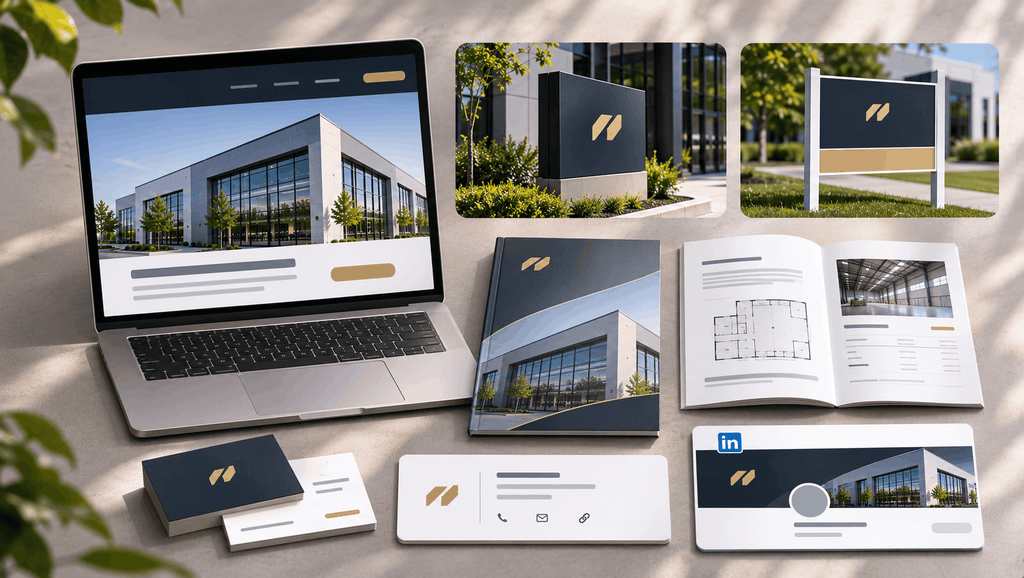
Once positioning is clear, the identity has to work everywhere your brand appears: building signage, yard signs, offering memoranda, email signatures, LinkedIn banners, and website headers.
Visual Identity
A strong CRE identity includes a primary logo and simplified versions, a restrained color palette, two typefaces at most, and photography and graphic guidelines. It should look sharp both on a 40-foot sign and in a small social media avatar. A professional brand identity development process builds these assets as a system rather than as separate pieces.
Verbal Identity
Your voice deserves the same discipline as your logo. Decide whether your brand sounds analytical, bold, advisory, or local, and document it with examples. When every broker writes listing descriptions and emails in a different voice, the brand fragments, even if the logo is consistent.
Templates for Repeat Materials
Offering memoranda, leasing flyers, pitch decks, and market reports should come from shared templates. Templates protect brand consistency, speed up production, and stop individual team members from improvising layouts under deadline pressure.
Brand Individual Properties With Intent
A property brand can lift leasing velocity and tenant perception, especially for new developments and repositioned assets.
Naming
A good property name is easy to say, easy to search, and tied to something real, such as the location, history, architecture, or intended community. Check that the name is available as a domain and not already used by a nearby property. Avoid names so generic that they disappear in search results.
Story and Placemaking
Tenants increasingly choose space for the experience as much as the square footage. A property brand should express what it is like to work, shop, or operate there, including amenities, access, nearby attractions, and the tenant mix. Signage, wayfinding, and lobby design should reinforce the same story the marketing tells.
A Dedicated Property Website
High-profile assets benefit from their own website or a dedicated section on the firm’s site. Include availability, floor plans, amenities, a neighborhood guide, and a clear leasing contact. Thoughtful website design turns that site into a working leasing tool rather than a digital brochure.
Lead With Market Expertise
In CRE, credibility is the brand. The fastest way to build it is to show your knowledge publicly and consistently.
Publish Market Insights
Quarterly submarket reports, vacancy commentary, rent trend summaries, and deal recaps position your firm as the source of truth in your niche. They also give owners and tenants a reason to subscribe, share, and remember you. Keep the format consistent so each report reinforces the brand.
Build Broker Personal Brands
Owners hire people, not logos. Encourage brokers to maintain complete LinkedIn profiles, share market commentary, and post closed-deal recaps under the firm’s visual identity. A team of visible experts strengthens the firm brand far more than a single corporate account.
Earn Media Coverage
Quotes in business journals, trade publications, and local news build authority that paid ads cannot buy. A focused public relations strategy pitches your brokers as commentators on market shifts, major deals, and development trends.
Protect the Brand With Proof and Consistency
A brand is a promise. Reviews, testimonials, and case studies are the evidence that you keep it.
Collect Client Proof
Ask satisfied owners, tenants, and investors for testimonials and Google reviews after successful deals. Turn your best transactions into short case studies that explain the challenge, your approach, and the outcome. Proof from named clients is especially persuasive in pitches for new listing assignments. A structured review management process makes collecting this proof routine instead of occasional.
Keep Every Touchpoint Aligned
Audit your brand twice a year. Check that syndicated listings, broker bios, email signatures, signage, and social profiles all reflect the current identity and positioning. Inconsistent materials quietly signal disorganization, which is the opposite of what clients want from a firm handling their most valuable assets.
Measure Whether Your Brand Is Working
Brand impact is harder to measure than ad clicks, but it is not invisible. Watch branded search volume, direct website traffic, and the number of inbound inquiries that mention your firm or broker by name. Track how often you are invited to pitch, your win rate on listing proposals, and renewal rates at branded properties. Rising numbers across these signals show that commercial real estate branding is building preference, not just awareness.
Commercial Real Estate Branding Questions Answered
What does branding mean in commercial real estate?
It is the process of shaping how the market perceives a CRE firm or property through positioning, visual identity, messaging, and experience. It covers the firm itself, individual assets, the tenant experience, and leasing or sale campaigns. Done well, commercial real estate branding helps owners, tenants, and investors choose you faster and with more confidence.
Do individual commercial properties need their own brand?
Not every property does. Single-tenant net lease assets and small buildings often work fine under the firm brand. Mixed-use developments, office towers, business parks, and lifestyle retail centers usually benefit from a distinct name, identity, and website, since a recognizable property brand supports leasing, tenant retention, and long-term value.
How long does it take to build a CRE brand?
A new identity system and website can launch in a few months, but market recognition takes longer. Expect consistent publishing, broker visibility, and client proof to build momentum over one to two years. Firms that stay consistent compound their results, while those that rebrand frequently reset their progress.
How is CRE branding different from residential real estate branding?
Residential branding often centers on individual agents and emotional home-buying decisions. CRE branding speaks to business decision-makers who weigh financial performance, location strategy, and risk. That means more emphasis on market expertise, deal track record, data-driven insights, and professional materials such as offering memoranda and market reports.
What is the first step in rebranding a commercial real estate firm?
Start with positioning, not design. Interview clients and brokers, review competitor messaging, and define what you want to be known for. Once the positioning statement is clear, build the visual identity, voice guidelines, templates, and website around it so every piece supports the same strategy.
Building a CRE Brand That Wins Mandates
The firms that win listings and fill buildings are rarely the loudest. They are the clearest about who they serve, the most consistent in how they show up, and the most generous with market knowledge. Start with positioning, build an identity system that scales, and back every promise with proof. LeadOrigin is an award-winning creative and digital marketing agency that helps firms turn brand strategy into measurable growth. Contact our team to start building a stronger CRE brand.