
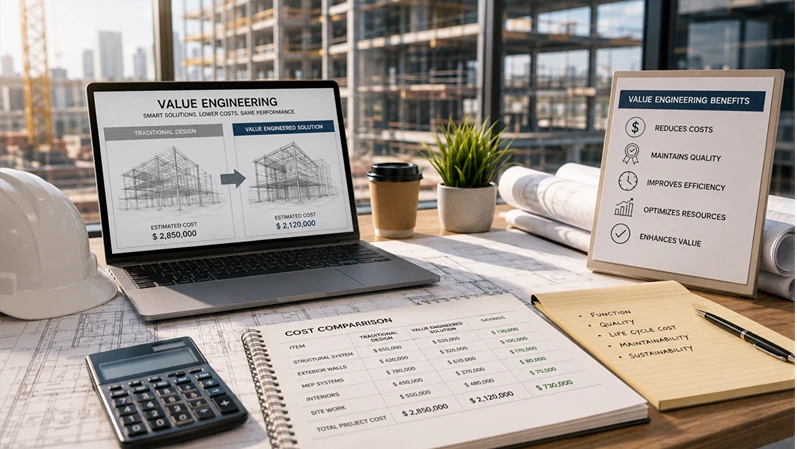
Business owners hearing the term “value engineering” for the first time sometimes worry it means cutting corners on quality to hit a budget number, especially after hearing horror stories from other project owners. In practice, understanding how value engineering reduces commercial construction costs reveals a much more disciplined process focused on eliminating unnecessary cost while preserving the functional and aesthetic goals a project actually needs to achieve.
Evaluating Lifecycle Cost, Not Just Upfront Price
The strongest value engineering decisions account for total cost of ownership rather than focusing exclusively on the initial construction number.
Comparing Upfront Cost Against Operating Expenses
A slightly more expensive HVAC system with meaningfully lower energy consumption often delivers better total value over a building’s lifespan than the cheapest available option, even though it costs more to install initially. Genuine value engineering weighs this full picture rather than optimizing for the lowest possible construction invoice.
Maintenance and Replacement Cycle Considerations
Materials and systems with longer service lives or lower maintenance requirements can reduce long-term facility costs substantially, even at a higher initial price point, making lifecycle analysis an essential part of any legitimate value engineering review.
What Value Engineering Actually Means

Clearing up the common misconception about this process is the first step toward using it effectively.
A Structured Review, Not Arbitrary Cutting
Value engineering is a structured, systematic review of a project’s design and specifications, evaluating whether each element delivers value proportional to its cost, rather than an arbitrary exercise in cutting whatever costs the most regardless of its actual function or importance.
Distinguishing Value Engineering From Cost Cutting
True value engineering asks whether a less expensive alternative can deliver equivalent performance and durability, while cost cutting simply removes scope or downgrades quality without that same rigorous evaluation. Confusing the two is why value engineering sometimes gets an undeserved reputation for compromising quality.
Value Engineering in Renovation and Adaptive Reuse Projects
Renovation projects present unique value engineering opportunities and constraints compared to ground-up new construction.
Working Within Existing Building Constraints
Existing structural, mechanical, and layout conditions limit some of the alternatives available in new construction, but they also create unique opportunities, such as reusing existing systems or structural elements rather than replacing them entirely, that a thorough value engineering review should specifically evaluate.
Balancing Preservation Goals With Cost Efficiency
Projects involving historic or architecturally significant existing buildings often need to balance preservation requirements against cost efficiency, requiring a more nuanced value engineering approach than a typical new construction project. Contractors experienced in navigating construction website content that reflects this kind of specialized expertise tend to attract owners specifically seeking this renovation and adaptive reuse experience.
When Value Engineering Should Happen in a Project
Timing matters significantly for how effective this process can be, and later is generally worse than earlier.
Early Design Phase Value Engineering
Conducting value engineering review during schematic or early design development gives the project team maximum flexibility to explore alternatives, since fewer decisions have been locked in and changes at this stage cost far less to implement than the same changes made later.
Late-Stage Value Engineering Is More Limited
Value engineering conducted after construction documents are largely complete has fewer viable options remaining, since many decisions are already embedded in finalized drawings, and changes at this stage often require costly rework of completed design work.
Measuring Value Engineering Results After Completion
Confirming whether value engineering decisions actually delivered the intended savings and performance requires looking back after the project is complete, not just trusting projections made during design.
Comparing Projected Savings to Actual Costs
Tracking whether the projected savings from value engineering decisions actually materialized in final construction costs gives owners and their teams useful data for evaluating which types of alternatives tend to deliver genuine value on future projects.
Monitoring Long-Term Performance of Substituted Materials
For material or system substitutions justified partly on long-term performance grounds, checking in after a year or two of actual building operation confirms whether those projected benefits are holding up as expected, informing better decisions on the next project.
Common Areas Where Value Engineering Finds Real Savings
Certain categories of a commercial project consistently offer more opportunity for meaningful savings than others.
Structural System Alternatives
Comparing structural system options, such as steel versus concrete framing for a given building type, can reveal significant cost differences without meaningfully affecting the finished building’s function or appearance to occupants.
Mechanical and Electrical System Efficiency
Evaluating alternative mechanical and electrical system configurations, sometimes combining equipment or simplifying distribution layouts, can reduce both installation cost and long-term operating expenses simultaneously, delivering value on two fronts rather than a one-time savings alone.
Finish Material Substitutions
Substituting a less expensive but functionally comparable finish material, while preserving the overall design intent and durability requirements, is one of the most commonly applied value engineering strategies, particularly for large surface areas like flooring or wall systems.
Tools That Support a More Rigorous Process
Modern estimating and modeling tools have made value engineering more precise and data-driven than the process looked like even a decade ago.
Cost Modeling Software for Faster Comparisons
Building information modeling paired with integrated cost estimating tools allows design teams to quickly compare the cost impact of different material or system choices, speeding up the value engineering process considerably compared to manual estimating for each alternative under consideration.
Historical Project Data as a Benchmark
Contractors and design teams with access to detailed cost data from past projects can benchmark proposed alternatives against real historical performance, rather than relying solely on manufacturer claims or generic industry estimates that may not reflect actual regional pricing and installation conditions.
Building a Disciplined Value Engineering Process
Getting genuine value from this process requires a structured approach rather than an unstructured brainstorming session.
Assembling the Right Review Team
Effective value engineering typically involves the architect, key engineers, and the contractor together, since evaluating tradeoffs properly requires understanding both the design intent and the practical cost and constructability implications of any proposed alternative.
Documenting Tradeoffs Transparently
Each proposed alternative should be documented with its cost impact, any performance or lifecycle tradeoffs, and a clear recommendation, giving the owner the information needed to make an informed decision rather than simply accepting or rejecting suggestions without full context.
Risks of Poorly Executed Value Engineering
When this process is rushed or poorly managed, it can genuinely undermine a project rather than improving it.
Sacrificing Long-Term Performance for Short-Term Savings
Some proposed alternatives reduce upfront construction cost but increase long-term maintenance or operating expenses, and a poorly executed review can miss this tradeoff entirely, creating a false sense of savings that costs more over the building’s actual lifespan.
Undermining Design Intent Without Owner Awareness
Value engineering conducted without adequate owner involvement can quietly erode design quality or functionality the owner actually cared about, simply because the tradeoff was never clearly communicated or understood at the time the decision was made.
How Value Engineering Fits Into Overall Budget Management
This process works best as one component of a broader, disciplined approach to managing a commercial construction budget.
Complementing Accurate Initial Estimating
Value engineering is most effective when paired with accurate initial cost estimating, since it functions best as a tool for optimizing an already realistic budget rather than trying to close a gap created by an unrealistic estimate from the very beginning.
Building Owner Trust Through Transparent Process
Owners who understand and actively participate in the value engineering process tend to trust the resulting decisions far more than owners who are simply presented with a final list of changes after the fact. Contractors who prioritize this kind of transparent collaboration tend to build stronger, longer relationships with clients focused on adding sustained project revenue rather than one-off transactional projects.
How Contractors Communicate Value Engineering Expertise
Contractors skilled at this process have a genuine differentiator worth highlighting clearly in how they market their services.
Demonstrating Past Value Engineering Success
Contractors who can point to specific past examples where value engineering delivered meaningful savings without compromising quality give prospective clients concrete evidence of this expertise, rather than a vague claim of cost consciousness. Firms building this kind of credibility often see it directly support how they generate qualified commercial construction leads from owners specifically concerned about budget discipline.
Positioning Value Engineering as Collaborative, Not Combative
Contractors who frame value engineering as a collaborative process aimed at maximizing the owner’s investment, rather than a defensive response to a budget problem, tend to build more trust with prospective clients evaluating multiple firms for a project.
Frequently Asked Questions About How Value Engineering Reduces Commercial Construction Costs
Does value engineering always mean lower quality?
No. Genuine value engineering evaluates whether alternatives deliver comparable performance and durability at a lower cost, rather than simply cutting scope or quality without that evaluation.
When is the best time to conduct value engineering?
Earlier is almost always better. Value engineering during early design phases offers far more flexibility and cost-saving potential than review conducted after construction documents are already largely complete.
How much can value engineering typically save on a commercial project?
Savings vary widely by project, but a disciplined process applied early in design can meaningfully reduce costs, sometimes by a significant percentage of the overall budget, without compromising the project’s core functional goals.
Who should be involved in the value engineering process?
Effective value engineering typically involves the architect, relevant engineers, and the contractor together, since evaluating tradeoffs properly requires both design intent understanding and practical cost and constructability knowledge.
Can value engineering hurt a project if done poorly?
Yes. Rushed or poorly documented value engineering can undermine long-term building performance or erode design intent the owner cared about, particularly when changes are made without adequate owner awareness and input.
Getting Genuine Value From the Value Engineering Process
Understanding how value engineering reduces commercial construction costs, without sacrificing the quality and function a project actually needs, comes down to timing, discipline, and transparent collaboration between owner, design team, and contractor throughout every phase of the project. Contractors ready to build this kind of budget-conscious reputation can explore proven marketing strategies for general contractors built around demonstrating exactly this expertise.