
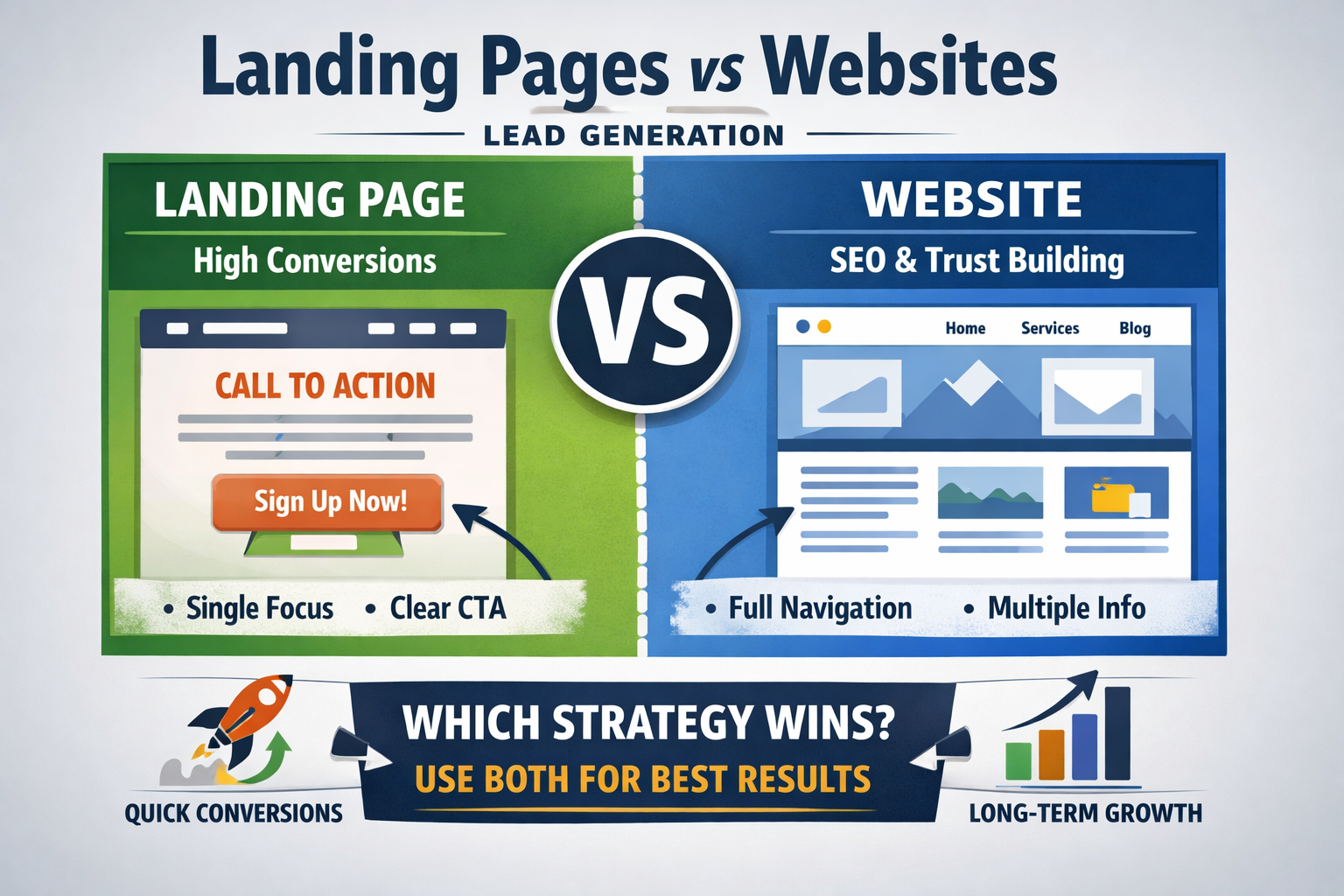
When it comes to landing pages vs. websites, the answer depends on the goal. If the objective is immediate lead capture, landing pages typically convert higher. If the goal is long-term brand building and SEO growth, a full website performs better over time.
A landing page is a focused, single-goal page designed to drive one action. A website is a multi-page platform built for brand visibility, content depth, and broader engagement.
For direct campaigns and paid traffic, a lead generation landing page often delivers a higher landing page conversion rate. For sustainable traffic and authority, a conversion-focused website supports long-term growth.
Do Landing Pages or Websites Convert Better?
In most paid advertising and direct-response campaigns, landing pages convert better than traditional websites. The reason is structural.
Landing pages remove distractions and guide visitors toward one clear action. Websites offer multiple pathways, which can dilute attention.
Typical differences include:
- Higher landing page conversion rate due to focused messaging
- Lower website conversion rate when navigation competes with calls to action
- Stronger message match between ads and landing pages
However, the question is not simply do landing pages convert better than websites. The real question is which tool aligns with your traffic source and user intent.
Quick Comparison at a Glance
| Factor | Landing Page | Website |
| Primary Goal | Single conversion action | Brand & multi-purpose engagement |
| Navigation | Minimal or none | Full navigation |
| Conversion Focus | High | Moderate |
| SEO Capability | Limited unless scaled | Strong long-term SEO growth |
| Best For | Paid campaigns, offers | Content marketing, authority building |
| Average Conversion Range | 5–15% | 1–3% |
This comparison clarifies the landing page vs website for lead generation debate. Each serves a different role within the funnel.
Why Landing Pages Usually Convert Higher
Landing pages are engineered around behavior psychology. Their structure supports immediate action rather than exploration.
1. Single-Focus Messaging
A lead generation landing page eliminates competing calls to action. Visitors encounter one problem, one solution, and one clear next step. Without multiple navigation options, attention remains fixed on conversion.
This clarity often increases the landing page conversion rate significantly.
2. Optimized Sales Funnel Structure
Landing pages sit inside structured high converting lead funnels. Traffic from ads or email campaigns lands on a page designed specifically for that audience segment.
The funnel typically follows:
Ad or keyword → Focused landing page → Conversion form or click-to-call
This alignment improves engagement and reduces bounce rates.
3. Better Message Match for Ads
Message match refers to the consistency between the ad copy and the landing page headline. When users click an ad and see the same promise reflected immediately, trust increases.
Websites often struggle with this because homepage messaging must serve multiple audiences.
Why Websites Still Matter for Lead Generation
Landing pages generate quick wins. Websites build sustainable growth.
1. SEO & Organic Traffic Growth
A website supports content depth, internal linking, and long-tail keyword targeting. Over time, this builds domain authority and organic visibility.
High converting sales funnels benefit from SEO traffic, which typically converts at a higher intent level.
2. Trust & Authority Signals
Visitors researching services often explore multiple pages. Case studies, blogs, about pages, and testimonials strengthen credibility.
A conversion-focused website builds long-term trust that landing pages alone cannot provide.
3. Multi-Service Businesses Need Structure
Businesses offering multiple services require structured navigation. A single landing page cannot represent complex offerings effectively.
In these cases, the website acts as the authority hub while landing pages function as targeted conversion assets.
Case Study Example (Agency Experience Scenario)
A strong real-world example of landing pages vs. websites in lead generation can be seen in a dermatology clinic’s campaign executed by LeadOrigin.
The clinic already had an established website with detailed service pages and strong brand presence. Organic visibility was growing, and the clinic had built trust within its market. However, paid campaigns were directing traffic to broader website pages that were designed for exploration rather than focused conversion.
Before Optimization
- Traffic directed primarily to general service pages
- Multiple navigation paths competing for attention
- Calls-to-action present but not dominant
- Lower conversion efficiency from paid campaigns
The website functioned effectively as a brand hub, yet high-intent traffic lacked a streamlined pathway to book appointments.
Strategy Implemented
LeadOrigin introduced dedicated, conversion-focused landing pages aligned with specific dermatology services and keyword clusters.
Instead of sending paid traffic to general pages, visitors landed on highly focused pages designed around one clear objective: scheduling an appointment.
Improvements included:
- Tight message alignment between ads and landing pages
- Prominent appointment scheduling buttons above the fold
- Simplified layout to reduce distractions
- Early placement of patient reviews and authority signals
- Mobile-first optimization for local search users
The main website continued serving long-term SEO and brand authority goals, while landing pages captured and converted high-intent traffic more effectively.
Results After Implementation
The impact extended beyond simple conversion metrics:
- 45% increase in new patient appointments
- 50% rise in overall website traffic
- Expansion from one location to three
- Growth of their online community and brand visibility
| Metric | Before Funnel Optimization | After Funnel Optimization |
| Appointment Growth | Moderate | +45% increase |
| Website Traffic | Steady | +50% increase |
| Location Presence | Single location | Expanded to 3 locations |
| Conversion Structure | Broad navigation | Dedicated landing funnels |
The growth was driven by strategic funnel refinement rather than traffic alone. The website built authority and supported SEO expansion. The landing pages captured high-intent visitors and converted them into scheduled appointments.
This example reinforces an important insight in the landing page vs website for lead generation discussion:
Websites create visibility and credibility. Landing pages accelerate action.
When used together strategically, they compound results rather than compete with each other.
When to Use Each (Strategic Framework)
Choosing between a landing page and a website depends on traffic source and objective.
Use a landing page when:
- Running paid ads
- Promoting a single offer
- Testing messaging
- Launching time-sensitive campaigns
Use a website when:
- Building SEO authority
- Supporting multiple services
- Nurturing long-term brand trust
- Publishing educational content
Understanding how to choose between a landing page and a website depends on funnel stage. High-intent traffic benefits from focused landing environments. Research-stage traffic benefits from website exploration.
So What Converts Better for Lead Gen?
If the goal is immediate lead capture, landing pages usually deliver a higher conversion rate. If the goal is scalable organic visibility and brand authority, websites support sustained growth.
The strongest lead generation strategies combine both:
- Landing pages for targeted campaigns
- Websites for SEO authority and brand trust
This integrated approach produces consistent results rather than isolated spikes.
References & Supporting Research
Frequently Asked Questions
Understanding landing pages vs. websites raises common questions.
Do landing pages always convert better than websites?
In direct-response campaigns, landing pages often convert at higher rates due to focused design. Websites may convert lower on a per-page basis but generate broader long-term engagement.
What is the average landing page conversion rate?
Industry averages range between 5% and 15%, depending on traffic quality and offer strength. Website conversion rates typically fall between 1% and 3%.
Can a homepage act as a landing page?
A homepage can function similarly if designed with single-focus messaging and minimal distractions. However, most homepages serve multiple audiences, which reduces conversion efficiency.
Is SEO better on a website or a landing page?
SEO performs better on structured websites because they support content depth, internal linking, and authority building. Landing pages are typically stronger for paid traffic campaigns.