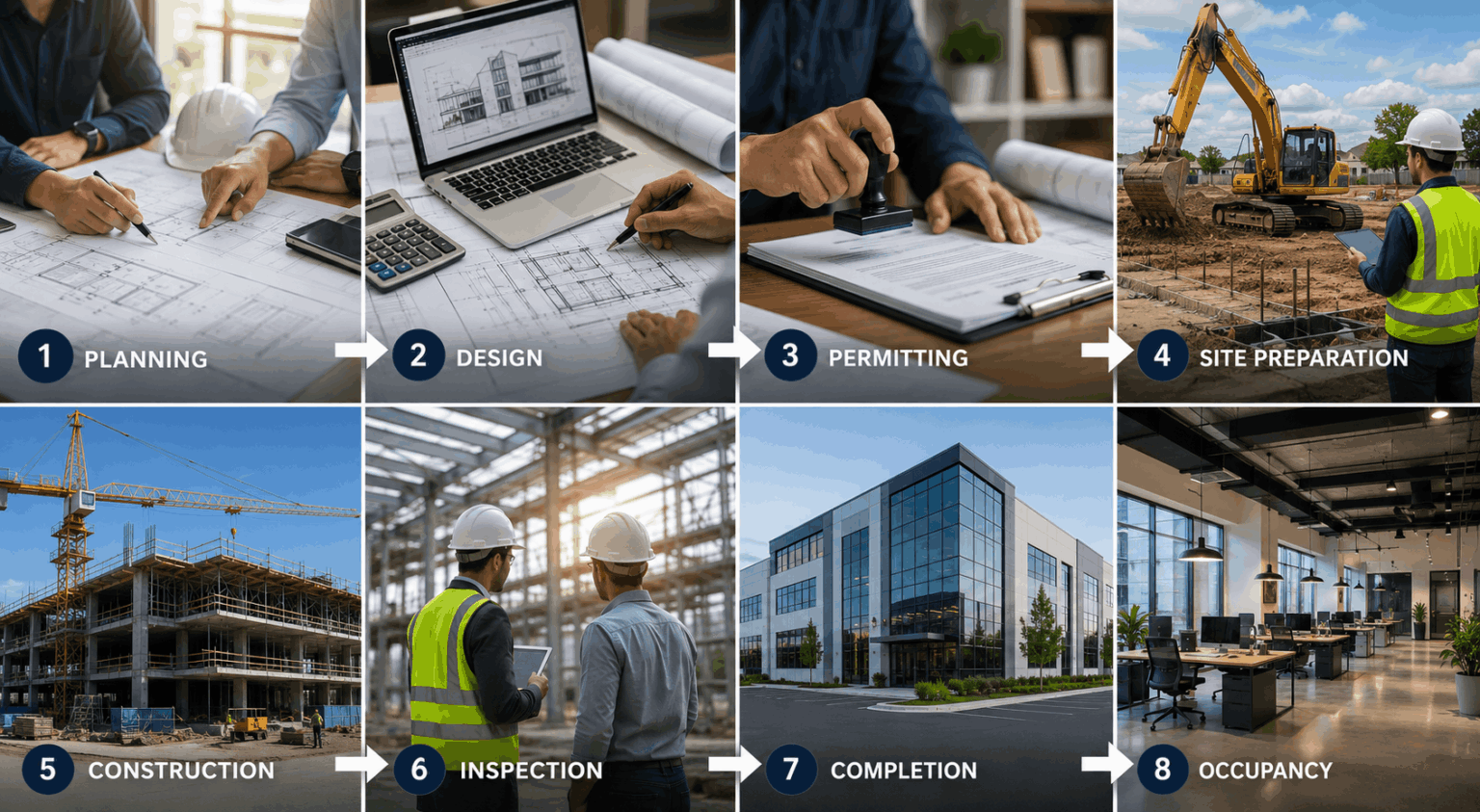
Business owners planning a commercial construction project often assume the delivery method is a minor administrative detail compared to choosing a contractor or finalizing a design. In reality, the choice between design-build vs. traditional construction shapes the entire project timeline, budget predictability, and how much day-to-day coordination falls on the owner throughout construction.
How Each Delivery Method Actually Works
Understanding the structural difference between these two approaches is the starting point for deciding which one fits a specific project.
Traditional Construction Separates Design and Build
In the traditional, or design-bid-build, model, an owner hires an architect to complete the design first, then solicits bids from contractors once drawings are finalized. This sequential process means design and construction happen as two distinct, separately contracted phases.
Design-Build Combines Both Under One Contract
Design-build consolidates design and construction responsibility under a single contract with one entity, typically led by the contractor or a joint design-build team. This structure allows construction planning to begin before design is fully finalized, since the same team controls both phases.
Handling Changes and Disputes During Construction
How each delivery method handles mid-project changes and disagreements is a practical concern owners often underestimate before breaking ground.
Change Orders Under Design-Build
Because one team controls both design and construction, change orders under design-build typically move through a single internal process, which can resolve faster but also gives the owner less independent leverage to negotiate pricing on the change itself.
Change Orders and Disputes Under Traditional Construction
Under traditional delivery, a change often requires coordination between the architect and contractor, which can slow the process but also provides an independent check on whether a proposed change and its associated cost are reasonable. Disputes between architect and contractor are also more common under this model, since each party has separate contractual interests.
Comparing Project Timelines
Timeline is often the single biggest factor driving an owner’s preference between these two approaches.
Design-Build Generally Compresses the Schedule
Because design and construction phases overlap rather than happening strictly in sequence, design-build projects frequently finish faster than an equivalent traditional project, since site work and early construction can begin while later design details are still being finalized.
Traditional Construction Requires Sequential Completion
Traditional delivery requires the full design to be complete and bid before construction begins, which adds time upfront but gives owners a fully finalized design to evaluate before committing to a contractor’s price.
Financing Considerations for Each Delivery Method
Lenders and financing structures sometimes respond differently to each delivery approach, which is worth understanding before a project is fully planned.
Lender Comfort With Guaranteed Maximum Price
Many lenders view the guaranteed maximum price common in design-build contracts favorably, since it provides more cost certainty for the loan being financed. This can sometimes simplify the financing process compared to a traditional project where final costs are not fully known until bidding concludes.
Phased Draws Under Traditional Construction
Traditional construction projects often align well with phased draw schedules tied to completed design milestones, giving lenders clear checkpoints tied to the separate design and construction phases. Owners should discuss financing structure with their lender early, regardless of delivery method, to avoid mismatched expectations partway through the project.
Cost Predictability and Risk Allocation
How financial risk is distributed between owner and contractor differs meaningfully between the two models.
Design-Build Shifts More Risk to a Single Entity
Because one entity holds responsibility for both design and construction, design-build contracts often include a guaranteed maximum price established earlier in the process, shifting more cost and coordination risk onto the design-build team rather than the owner.
Traditional Construction Offers More Owner Control Over Bidding
Competitive bidding among multiple contractors under the traditional model can produce more competitive pricing, though owners retain more responsibility for coordinating between separate architect and contractor relationships if issues arise during construction.
Staffing and Internal Resource Demands
The amount of internal staff time an owner neecdfe34ds to dedicate to managing a project also differs meaningfully between the two delivery methods.
Design-Build Reduces Owner Coordination Burden
Because a single team handles both design and construction, owners generally spend less time coordinating between separate parties, which can be a significant advantage for business owners who need to stay focused on running their core operations rather than managing a complex construction project.
Traditional Construction Requires More Active Owner Involvement
Owners under the traditional model often need to actively facilitate communication between the architect and contractor, particularly when questions arise about how a design detail should be interpreted or constructed. This requires more ongoing owner attention throughout the project, or the hiring of a dedicated owner’s representative to manage that coordination.
Quality Control and Design Flexibility
Each delivery method handles design changes and quality oversight differently once a project is underway.
Design-Build Allows Easier Mid-Project Adjustments
Because the same team manages both design and construction, adjusting design details as construction progresses tends to be more straightforward under design-build, since there is no separate architect relationship to renegotiate changes through.
Traditional Construction Provides Independent Design Oversight
Some owners prefer that an independent architect, separate from the construction team, reviews quality and holds the contractor accountable to the original design intent, which is a structural advantage traditional delivery offers that design-build does not inherently provide.
How Permitting Fits Into Each Timeline
Permitting requirements apply regardless of delivery method, but how permitting integrates into the schedule differs between the two approaches.
Permitting Can Overlap With Early Design-Build Construction
Some design-build projects submit permits for site work or foundation packages while architectural details for later phases are still being finalized, allowing permitting and early construction to proceed in parallel rather than waiting for a fully complete design package.
Traditional Construction Ties Permitting to Final Design
Under traditional delivery, permits are typically submitted only once the full design is finalized, since the complete drawing set is usually required for a thorough permit review. This adds a sequential step to the overall timeline that design-build projects can sometimes compress.
Which Projects Favor Each Approach
Certain project types and owner priorities align more naturally with one delivery method over the other.
When Design-Build Makes the Most Sense
Projects with a firm deadline, a need for cost certainty early in planning, or an owner who prefers a single point of contact throughout the project often favor design-build. Owners focused on getting a facility operational as quickly as possible, in order to start generating commercial construction leads and revenue from the finished space, frequently lean toward this compressed timeline.
When Traditional Construction Makes the Most Sense
Highly customized or architecturally complex projects, where an owner wants maximum design control and independent oversight before committing to construction pricing, often favor the traditional model despite its longer upfront timeline.
Questions to Ask Before Committing to Either Method
A short list of direct questions during early planning conversations helps owners avoid committing to a delivery method that does not actually fit their project.
Clarifying Priorities Before Talking to Contractors
Owners should identify their top priority, whether that is speed, cost certainty, design control, or minimizing their own time commitment, before entering conversations with contractors or architects, since that priority often points clearly toward one delivery method over the other.
Asking Contractors About Their Typical Delivery Approach
Not every contractor offers both delivery methods, and asking directly which approach a firm specializes in, along with examples of recently completed projects under that method, helps owners quickly narrow down which firms are actually a good fit for their preferred approach.
Evaluating Contractors Under Either Model
Regardless of which delivery method an owner chooses, evaluating the contractor or design-build team properly is essential to project success.
Reviewing Past Project Experience
Owners should review a contractor’s history with projects of similar scope and delivery method, since experience specifically with design-build coordination differs from experience managing traditional, separately bid construction. Understanding what contributes to lead and project quality in a contractor’s own business gives owners useful insight into how that same contractor is likely to manage communication and quality on an actual project.
Confirming Communication Structure Upfront
Owners should clarify exactly who they will communicate with throughout the project, how issues get escalated, and how design changes are documented, regardless of which delivery method is chosen. This clarity prevents the kind of confusion that leads to costly delays or disputes later in construction.
How Contractors Attract the Right Kind of Project Owners
The delivery method a contractor specializes in shapes how they should present their services to prospective commercial clients.
Marketing Design-Build Expertise Clearly
Contractors who specialize in design-build should clearly communicate this capability in their marketing, since owners searching for a faster, single-point-of-contact delivery method are specifically looking for this expertise rather than a general contractor. Firms focused on generating qualified commercial construction leads benefit from making this specialization obvious from the first page a prospective client visits.
Building Trust With Potential Clients Early
Commercial construction represents a significant investment for any business owner, and building trust online before a project even begins meaningfully shapes which contractors make it onto a shortlist for either delivery method.
Frequently Asked Questions About Design-Build vs. Traditional Construction
Is design-build always faster than traditional construction?
Generally yes, since design and construction phases overlap rather than happening strictly in sequence, though the actual time savings depend on project complexity and how efficiently the design-build team coordinates.
Which delivery method is more cost-effective?
Neither is universally cheaper. Design-build often provides more cost certainty earlier in the process, while traditional construction’s competitive bidding can produce lower initial pricing, though with less budget certainty upfront.
Can I switch delivery methods partway through a project?
It is very difficult and costly to switch once a project has started, since the contractual structure and risk allocation are fundamentally different between the two models. This decision should be made carefully before signing any contracts.
Does design-build mean less design control for the owner?
Not necessarily, but owners typically have less independent oversight compared to hiring a separate architect under traditional delivery, since the design-build team manages both design and construction internally.
Which delivery method is better for a highly customized building?
Traditional construction often suits highly customized, architecturally complex projects better, since it allows for a fully independent, finalized design before construction pricing and scheduling are committed.
Choosing the Delivery Method That Fits Your Project
Deciding between design-build vs. traditional construction comes down to how an owner prioritizes speed, cost certainty, and design control for their specific project, not which method is universally superior. Contractors ready to attract owners making this exact decision can explore proven marketing strategies for general contractors built around clearly communicating delivery method expertise.