Post-construction cleanup is one of the most profitable services a commercial cleaning company can sell and one of the hardest to sell consistently. The work is high margin, but it arrives in unpredictable bursts, the buyer is a general contractor with no patience for slow responses, and pricing mistakes can erase a quarter of profit on a single job. Winning more post-construction cleaning jobs comes down to being findable when a project manager needs someone this week, bidding with enough accuracy to protect margin, and building the contractor relationships that produce repeat work without a bid at all.
Understand Who Actually Buys This Service
The Buyer Is Not the Building Owner
Your customer is usually a general contractor, a construction manager, or a project superintendent. That person is judged on schedule and turnover date, not on cleaning quality. They care about whether you can mobilize a crew on short notice, whether you will fail a walkthrough and delay a certificate of occupancy, and whether you carry the insurance their contract requires.
The Buying Window Is Extremely Short
Construction cleanup gets scheduled late, often after everything else has slipped. A superintendent who calls on Tuesday needs a number by Wednesday and a crew by the following Monday. Companies that treat these inquiries like a standard janitorial bid, with a site visit scheduled for the following week, lose the job before they quote.
One Relationship Produces Years of Work
A single general contractor may run six to fifteen projects a year. Winning one job on merit and performing well converts into a standing vendor relationship that bypasses competitive bidding entirely. That makes the economics of this service unusual: your acquisition cost on the first job matters far less than your retention on the fifth.
Be Findable at the Moment the Project Manager Searches

Own the Local Search Results for Cleanup Terms
Contractors search the same way everyone else does. Terms like “post construction cleaning near me,” “final clean contractor,” and “construction cleanup company” carry strong commercial intent and low content competition compared to general janitorial keywords. Ranking for them requires a dedicated service page rather than a bullet on your services list, plus the local SEO foundations that put you in the map pack.
Your Google Business Profile Does the Screening
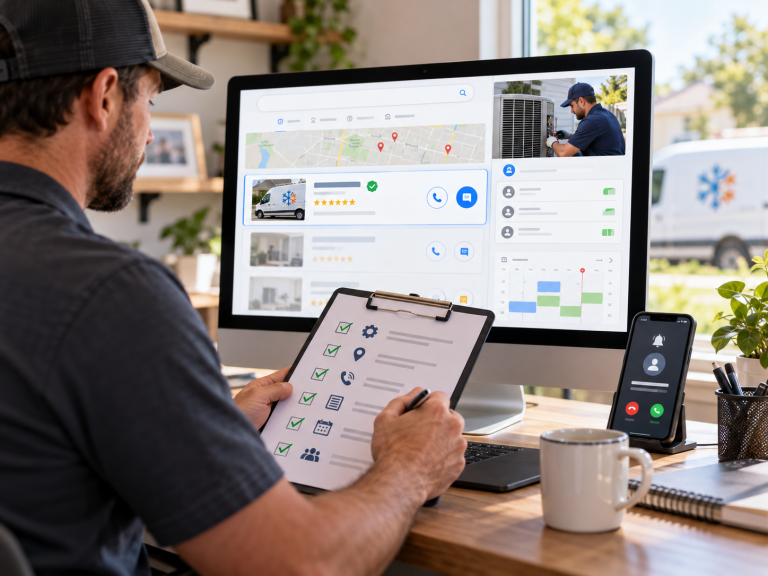
Before anyone calls, they check your profile: photos, category, service area, and reviews. A profile showing jobsite photos and recent activity reads as an active contractor rather than a residential maid service that occasionally takes commercial work. Getting the Google Business Profile setup right for commercial cleaning visibility is often the difference between appearing in the top three results and not appearing at all.
Build a Page That Speaks Construction, Not Janitorial
A page that describes rough clean, final clean, and touch-up clean as distinct phases, lists what your crew handles at each stage, and states your insurance limits and OSHA training will convert contractors far better than generic cleaning copy. Sharpening your service messaging for commercial cleaning so it uses the buyer’s vocabulary is one of the cheapest conversion improvements available.
Respond Faster Than Your Competition
Speed decides more of these jobs than price does. A superintendent who sends three requests will often award the work to whoever answers first with a credible number, because their real constraint is time. Companies that acknowledge an inquiry within minutes, ask two or three qualifying questions, and commit to a walkthrough within 24 hours win a disproportionate share of the work they bid. The connection between response time and commercial cleaning quote requests is direct and measurable, and it is usually the first place a cleaning company should look when close rates are soft.
Bid With Enough Precision to Keep the Margin
Price by Phase, Not by Square Foot Alone
Rough clean, final clean, and post-punch touch-up carry very different labor loads. Quoting one blended per-square-foot rate for the entire project is how companies lose money on jobs they were excited to win. Break the scope into phases with separate pricing so scope creep becomes a change order instead of unpaid labor.
Walk the Site Before You Commit
Photographs lie about debris volume. A short walkthrough tells you what the drawings will not: how much adhesive residue is on the glass, whether the concrete has been sealed, how many stories you are hauling debris down, and whether trades are still working. Companies that skip the walkthrough to save an hour usually pay for it in crew overtime.
Write Exclusions Into Every Proposal
State clearly what is not included: debris removal beyond a defined volume, exterior work, remediation, repeated cleanings caused by trades returning to the space, and standby time when the site is not ready. Contractors respect a proposal with clear boundaries because it matches how their own subcontracts are written.
Confirm the Insurance and Compliance Requirements Early
Most commercial projects require specific general liability and workers compensation limits, additional insured endorsements, and sometimes bonding. Knowing your limits and having certificates ready to send the same day removes a common reason bids get quietly dropped.
Build the Contractor Relationships That Produce Repeat Work
Target General Contractors Directly
The most reliable pipeline in this category is built through outreach, not inbound traffic. Identify the general contractors, construction managers, and developers active in your market, then approach project managers and superintendents rather than head office. Consistent email marketing to that list keeps you in mind between projects, when nobody is actively searching.
Follow Local Project Activity
Permit filings, construction reports, and industry association directories tell you which builders have work coming. Reaching a superintendent while a project is still in framing gives you months of relationship time before the cleanup bid goes out.
Make Reviews and Proof Part of the Pitch
Contractors want evidence that you have done this before at this scale. Before-and-after jobsite photography, project references, and current reviews carry more weight than any claim on your website. The value of client reviews in commercial cleaning marketing is especially high here, because a project manager is putting their turnover date in your hands.
Turn One Project Into a Standing Vendor Relationship
Performance is the marketing. Hit the schedule, pass the walkthrough the first time, communicate daily during the final clean, and invoice accurately. Then follow up deliberately: ask the superintendent what the next project is, ask to be added to the preferred vendor list, and ask whether the building needs recurring janitorial service now that it is occupied. Post-construction cleaning jobs frequently convert into ongoing maintenance contracts, which is where the real lifetime value of this service sits.
Measure What Predicts Revenue

Track bid-to-win rate by contractor, average job value by phase, gross margin per project after actual labor hours, and how many post-construction clients converted into recurring accounts. Most companies discover that two or three contractors account for the majority of their profitable work, which tells you exactly where to concentrate relationship effort and where to stop chasing one-off bids.
FAQs About Winning Post-Construction Cleaning Jobs
How should post-construction cleaning be priced?
Most companies price by phase using square footage as a starting point, then adjust for debris volume, ceiling height, glass quantity, floor type, and site access. Bidding by production hours rather than by area alone gives far more accurate results, particularly on projects with heavy adhesive, paint overspray, or multi-story debris hauling.
How do cleaning companies find general contractors to work with?
Building permit records, construction industry associations, local builder directories, and existing property management relationships all surface active contractors. Direct outreach to project managers and superintendents, supported by consistent follow-up, generally produces better results than waiting for bid invitations.
What insurance do contractors typically require?
General liability and workers compensation are standard, often with additional insured endorsements naming the general contractor and the owner. Limits vary by project size, and some larger commercial jobs require umbrella coverage or bonding. Confirm requirements before bidding so you are not disqualified after submitting.
How fast do you need to respond to a cleanup inquiry?
Same day, ideally within the hour. Construction cleanup is scheduled under time pressure, and the contractor is typically contacting several vendors at once. The first credible response frequently gets the walkthrough, and the walkthrough usually decides the award.
Does SEO work for this service or is it all relationship-driven?
Both matter. Relationships produce the repeat work, but search brings in the new contractors who have not used you before, especially when their usual vendor is unavailable. A dedicated service page and a well-optimized business profile capture those urgent searches, which often become long-term accounts.
Building a Steadier Pipeline of Construction Cleanup Work
The companies that dominate this niche are not the cheapest bidders. They are the ones that show up in search when a superintendent is under pressure, respond before anyone else, price with enough precision to stay profitable, and perform well enough to skip the bidding process next time. LeadOrigin builds that combination of visibility, messaging, and lead follow-up for commercial service businesses across Texas and nationwide. Talk with our team about turning inconsistent bid requests into a predictable pipeline.